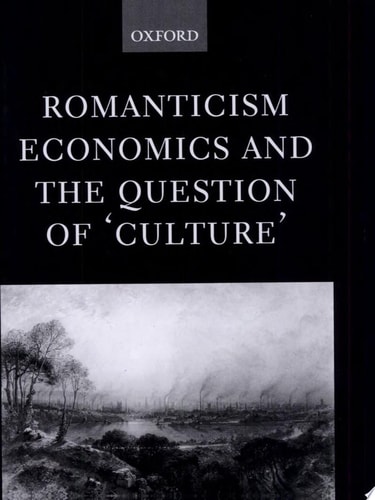
Romanticism, Economics and the Question of 'Culture'
0
0
As an Amazon Associate and affiliate partner, Menrva Books earns from qualifying purchases. Learn more
Author Description
The Romantic age in Britain formed one of the most celebrated--and heterogeneous--moments in literary history, but it also witnessed the rise of "political economy" as the pre-eminent nineteenth-century science of society. Romanticism, Economics and the Question of 'Culture' investigates this historical conjunction, and reassesses the idea that the Romantic defense of spiritual and humanistic "culture" developed as a reaction to the individualistic, philistine values of the "dismal science."Drawing on a wide range of source material, the book combines the methods of literary scholarship and intellectual history. It addresses the changing political identifications of familiar literary figures such as Wordsworth, Coleridge, and Shelley, but also illuminates the wider political and intellectual life of this period.Romanticism, Economics and the Question of 'Culture' situates canonical Romantic writers within a nuanced, and highly detailed ideological context, while challenging our inherited understanding of the Romantic tradition itself as the social conscience of nineteenth-century capitalism.
Menrva's Summary
THE THESIS
This book investigates the historical intersection between British Romanticism and the emergence of political economy to challenge the assumption that Romantic culture was merely a reactive defense against capitalist values. Philip Connell, a scholar of British literature and intellectual history, utilizes a broad array of primary source materials to re-examine the ideological landscape of the nineteenth century. By analyzing the political shifts of major literary figures, the text argues that the relationship between humanistic culture and economic science was far more complex and integrated than traditional narratives suggest.
THE SCOPE MAP
What You Will Find
- An analysis of the intellectual history of nineteenth-century Britain regarding the rise of political economy.
- A reassessment of the political identifications of canonical figures including Wordsworth, Coleridge, and Shelley.
- A synthesis of literary scholarship and historical methodology to map ideological contexts.
- A critique of the inherited view of Romanticism as the primary social conscience of early capitalism.
THE AUTHORITY PERSPECTIVE
Scholars and historians recognize this work as a rigorous contribution to the study of Romantic-era intellectual history. Readers frequently note the academic density of the prose, which serves as a foundational text for those examining the intersection of literature and social science in the nineteenth century.
Page Count:
350
Publication Date:
2005-05-26
Publisher:
Oxford University Press
ISBN-10:
0199282056
ISBN-13:
9780199282050
Economics
History
Literary Criticism
Romanticism
Intellectual History
British literature