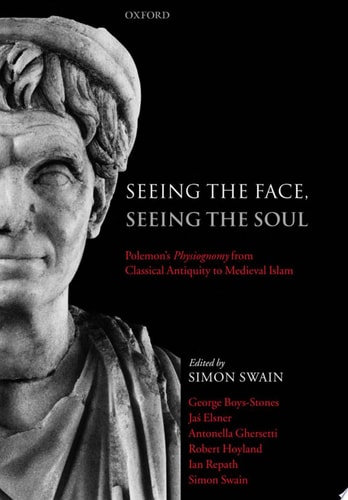
Seeing the Face, Seeing the Soul: Polemon's Physiognomy from Classical Antiquity to Medieval Islam
0
0
As an Amazon Associate and affiliate partner, Menrva Books earns from qualifying purchases. Learn more
Author Description
Polemon of Laodicea (near modern Denizli, south-west Turkey) was a wealthy Greek aristocrat and a key member of the intellectual movement known as the Second Sophistic. Among his works was the Physiognomy, a manual on how to tell character from appearance, thus enabling its readers to choose friends and avoid enemies on sight. Its formula of detailed instruction and personal reminiscence proved so successful that the book was re-edited in the fourth century by Adamantius in Greek, translated and adapted by an unknown Latin author of the same era, and translated in the early Middle Ages into Syriac and Arabic. The surviving versions of Adamantius, Anonymus Latinus, and the Leiden Arabic more than make up for the loss of the original.The present volume is the work of a team of leading Classicists and Arabists. The main surviving versions in Greek and Latin are translated into English for the first time. The Leiden Arabic translation is authoritatively re-edited and translated, as is a sample of the alternative Arabic Polemon. The texts and translations are introduced by a series of masterly studies that tell the story of the origins, function, and legacy of Polemon's work, a legacy especially rich in Islam. The story of the Physiognomy is the story of how one man's obsession with identifying enemies came to be taken up in the fascinating transmission of Greek thought into Arabic.
Menrva's Summary
THE THESIS
This volume investigates the historical transmission, intellectual function, and cultural legacy of Polemon of Laodicea’s Physiognomy from its origins in the Second Sophistic to its adaptation within medieval Islamic thought. The authors, a collaborative team of Classicists and Arabists, utilize a comparative analysis of surviving Greek, Latin, Syriac, and Arabic manuscripts to reconstruct the evolution of physiognomic practice. By examining how a manual for identifying character through physical appearance migrated across linguistic and cultural boundaries, the text argues that Polemon’s work served as a critical bridge for the reception of Greek intellectual traditions in the Islamic world.
THE SCOPE MAP
What You Will Find
- English translations of the primary Greek and Latin versions of the Physiognomy.
- A re-edited and translated version of the Leiden Arabic manuscript.
- Comparative studies detailing the adaptation of physiognomic theory in medieval Islamic contexts.
- Scholarly analysis regarding the origins and social utility of physiognomy as a tool for interpersonal assessment.
THE AUTHORITY PERSPECTIVE
Experts recognize this volume as a foundational resource for scholars interested in the intersection of classical rhetoric and medieval Arabic intellectual history. Readers frequently note the academic density of the prose and the precision of the textual apparatus provided by the contributors.
Page Count:
600
Publication Date:
2007-05-10
Publisher:
Oxford University Press
ISBN-10:
0199291535
ISBN-13:
9780199291533
History
Philosophy
Translation Studies
Physiognomy
Cultural History
Community Tags
Similar Books