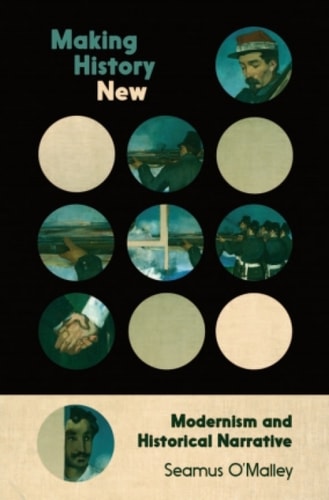
Making History New: Modernism and Historical Narrative
0
0
As an Amazon Associate and affiliate partner, Menrva Books earns from qualifying purchases. Learn more
Author Description
Guided by Ezra Pound's dictum --"Make it new"--a generation of writers set out to create fiction and poetry that was unlike anything that came before it. However, as Seamus O'Malley shows, historical narrative was a key site for modernist experimentation. Taking three of literary modernism's major figures--Joseph Conrad, Ford Madox Ford, and Rebecca West--Making History New demonstrates how the movement's literature not only engaged with history but also transformed traditional approaches to its telling in unique ways.Informed by Paul Ricoeur's belief that narrative is necessary to comprehend historical processes, the study closely examines four major modernist historical novels. Conrad's Nostromo interrogates the very term "history," as it relates the political tumult of a fictitious Latin American country; while Ford's The Good Soldier mirrors the cyclical nature of historiography with a protagonist who returns repeatedly to intense periods of his own past to better comprehend them. Two epochal World War I novels-The Return of the Soldier and Parade's End-depict shell-shocked veterans that illustrate the paradox of an accurate historical rendering achieved through the process of amnesia. These novels, in O'Malley's view, lead to the high point of what he terms "modernist historiography": Rebecca West's innovative 1941 travelogue Black Lamb and Grey Falcon and its preoccupation with "history's impossibility."The monograph concludes with a brief consideration of how historians since World War II have adopted some of the approaches to narrative inaugurated by literary modernists while wrestling with how to relate unthinkable atrocities such as genocide. Ultimately, Making History New foregrounds narrative's essential role as a bridge between fiction and history, as it explores the process by which collective human experience becomes historical narrative.
Menrva's Summary
THE THESIS
This study investigates how literary modernism transformed the conventions of historical narrative by challenging traditional methods of documenting the past. Seamus O'Malley, an academic scholar, utilizes the philosophical framework of Paul Ricoeur to argue that narrative remains a vital tool for human comprehension of historical processes. By analyzing the works of Joseph Conrad, Ford Madox Ford, and Rebecca West, the author demonstrates that modernist writers did not merely ignore history but actively reconstructed it through experimental techniques. The text posits that these literary innovations provided a new vocabulary for historians to address complex, traumatic events in the post-World War II era.
THE SCOPE MAP
What You Will Find
- Analysis of four major modernist historical novels including Nostromo, The Good Soldier, The Return of the Soldier, and Parade's End.
- Examination of Rebecca West's travelogue Black Lamb and Grey Falcon as a pinnacle of modernist historiography.
- Application of Paul Ricoeur's narrative theory to literary texts.
- Discussion on the intersection of literary experimentation and the documentation of genocide and war.
THE AUTHORITY PERSPECTIVE
Scholars and students of literary modernism recognize this work as a significant contribution to the study of historiography within fiction. The text is noted for its academic rigor and its ability to bridge the gap between literary analysis and historical methodology.
Page Count:
296
Publication Date:
2014-01-01
Publisher:
Oxford University Press
ISBN-10:
0199364249
ISBN-13:
9780199364244
History
English & College Success
English fiction
Literary theory
English
European History
Historiography
FICTION Historical
Literary Criticism
Modernism
Community Tags
Similar Books