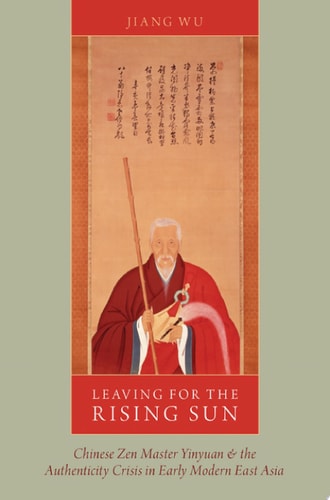
Leaving for the Rising Sun: Chinese Zen Master Yinyuan and the Authenticity Crisis in Early Modern East Asia
0
0
As an Amazon Associate and affiliate partner, Menrva Books earns from qualifying purchases. Learn more
Author Description
In 1654 Zen Master Yinyuan traveled from China to Japan. Seven years later his monastery, Manpukuji, was built and he had founded a new tradition, called Obaku. In this sequel to his 2008 book, Enlightenment in Dispute, Jiang Wu tells the story of the tremendous obstacles faced by Yinyuan, drawing parallels between his experiences and the broader political and cultural context in which he lived. Yinyuan claimed to have inherited the "Authentic Transmission of the Linji Sect." After arriving in Japan, he was able to persuade the Shogun to build a new Ming-style monastery for the establishment of his Obaku school. His arrival in Japan coincided with a series of historical developments, including the Ming-Qing transition, the consolidation of early Tokugawa power, the growth of Nagasaki trade, and rising Japanese interests in Chinese learning and artistic pursuits. While Yinyuan's travel is known in scholarly circles, the significance of his journey within East Asian history has not been fully explored. Leaving for the Rising Sun provides a unique opportunity to reexamine the crisis in the continent and responses from other parts of East Asia. Using Yinyuan's story as a bridge between China and Japan, Wu demonstrates that the monk's significance is far greater than the temporary success of a religious sect. Rather, Yinyuan imported to Japan a new discourse of authenticity that gave rise to indigenous movements that challenged, and led to the eventual breakup of, a China-centered world order.
Menrva's Summary
THE THESIS
This work investigates how the migration of Zen Master Yinyuan from China to Japan in 1654 catalyzed a shift in the cultural and political landscape of early modern East Asia. Jiang Wu, a scholar of Chinese Buddhism, utilizes primary historical records and monastery archives to argue that Yinyuan’s establishment of the Obaku school was not merely a religious expansion, but a pivotal moment that introduced a new discourse of authenticity. By examining the intersection of the Ming-Qing transition and Tokugawa consolidation, the author demonstrates how this religious movement challenged the existing China-centered world order.
THE SCOPE MAP
What You Will Find
- Historical analysis of the Ming-Qing transition and its impact on regional religious movements.
- Examination of the establishment and cultural influence of the Manpukuji monastery in Japan.
- Primary source research detailing the political negotiations between Yinyuan and the Tokugawa Shogunate.
- A framework for understanding the evolution of the Obaku school and its role in the shifting geopolitical dynamics of the 17th century.
THE AUTHORITY PERSPECTIVE
Scholars recognize this text as a significant contribution to the study of East Asian religious history and cross-cultural exchange. Readers frequently note the academic rigor and the depth of the historical context provided regarding the Obaku school's influence on regional identity.
Page Count:
384
Publication Date:
2014-01-01
Publisher:
Oxford University Press
ISBN-10:
0199393141
ISBN-13:
9780199393145
History
Biography
Religion
Zen Buddhism
Asian History
Buddhism
Community Tags
Similar Books