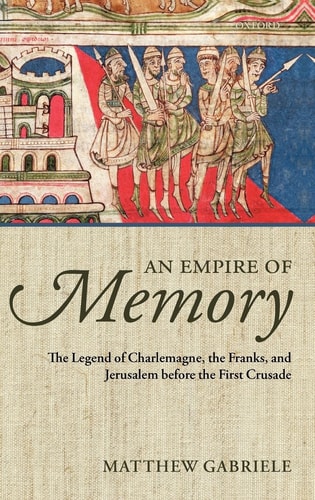
An Empire of Memory: The Legend of Charlemagne, the Franks, and Jerusalem before the First Crusade
0
0
As an Amazon Associate and affiliate partner, Menrva Books earns from qualifying purchases. Learn more
Author Description
Beginning shortly after Charlemagne's death in 814, the inhabitants of his historical empire looked back upon his reign and saw in it an exemplar of Christian universality - Christendom. They mapped contemporary Christendom onto the past and so, during the ninth, tenth, and eleventh centuries, the borders of his empire grew with each retelling, almost always including the Christian East. Although the pull of Jerusalem on the West seems to have been strong during the eleventh century, it had a more limited effect on the Charlemagne legend. Instead, the legend grew during this period because of a peculiar fusion of ideas, carried forward from the ninth century but filtered through the social, cultural, and intellectual developments of the intervening years.Paradoxically, Charlemagne became less important to the Charlemagne legend. The legend became a story about the Frankish people, who believed they had held God's favour under Charlemagne and held out hope that they could one day reclaim their special place in sacred history. Indeed, popular versions of the Last Emperor legend, which spoke of a great ruler who would reunite Christendom in preparation for the last battle between good and evil, promised just this to the Franks. Ideas of empire, identity, and Christian religious violence were potent reagents. The mixture of these ideas could remind men of their Frankishness and move them, for example, to take up arms, march to the East, and reclaim their place as defenders of the faith during the First Crusade.An Empire of Memory uses the legend of Charlemagne, an often-overlooked current in early medieval thought, to look at how the contours of the relationship between East and West moved across centuries, particularly in the period leading up to the First Crusade.
Menrva's Summary
THE THESIS
How did the evolving legend of Charlemagne shape the Frankish identity and influence the ideological motivations behind the First Crusade? Matthew Gabriele, a scholar of early medieval history, examines how the memory of Charlemagne was reconstructed between the ninth and eleventh centuries to serve as a framework for Christian universality. By analyzing contemporary texts and cultural shifts, the author argues that the legend of the 'Last Emperor' provided the Franks with a sense of sacred purpose that ultimately facilitated the mobilization of religious violence in the East.
THE SCOPE MAP
What You Will Find
- Analysis of the evolution of the Charlemagne legend from the ninth to the eleventh centuries.
- Examination of the intersection between Frankish identity, imperial ideology, and religious fervor.
- Investigation into the historical relationship between the Christian West and the East prior to the First Crusade.
- Discussion of the 'Last Emperor' myth and its role in shaping medieval political and religious expectations.
THE AUTHORITY PERSPECTIVE
Historians and medievalists recognize this work as a significant contribution to the study of early medieval memory and the ideological origins of the Crusades. Readers frequently note the academic rigor of the prose and the author's ability to synthesize complex cultural shifts into a coherent historical narrative.
Page Count:
256
Publication Date:
2011-05-12
Publisher:
Oxford University Press
ISBN-10:
019959144X
ISBN-13:
9780199591442
Religion
History
European History
Cultural History
Community Tags
Similar Books