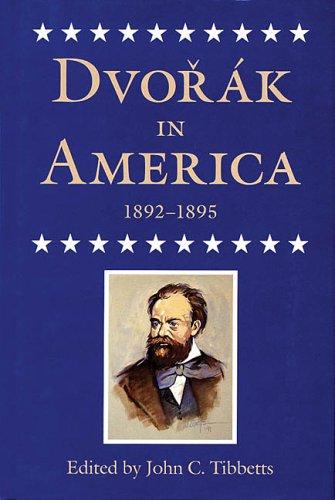
Dvořák in America, 1892-1895
0
0
As an Amazon Associate and affiliate partner, Menrva Books earns from qualifying purchases. Learn more
Author Description
In 1892 the Bohemian composer Antonin Dvorak arrived in New York City, where from 1892 to 1895 he worked as the director of the National Conservatory. "I did not come here to interpret Beethoven or Wagner for the public," he said, "but to give what encouragement I can to the young musicians of America... I came to discover what young Americans have in them and to help them express it. The new American school of music must strike its roots deeply into its own soil." Dvorak, a foreigner in a land filled with foreigners, had an ear freshly attuned "to the voice of the people," as he put it - the voice he heard in "the Negro melodies, the songs of the creoles, the red man's chant, or the plaintive ditties of the homesick Germans and Norwegians." By precept and example, he inspired his pupils and friends - such as Will Marion Cook, Harry T. Burleigh (both African Americans), Horatio Parker, and Maurice Arnold - to forge a uniquely American tradition; they, in turn, became mentors and teachers to a new generation of composers, including Charles Ives, George Gershwin, Aaron Copland, and Duke Ellington. Dvorak heard for himself the "dialects and idioms... commingled in this great country" and expressed them in his own way in a dozen masterpieces written during his visit. His "New World" Symphony, for example - still the most famous ever written on American soil - was composed in New York amid what he called the "American push" of the streets. And two of his most celebrated chamber works, the F Major Quartet and the E-flat Major Quintet, were written during his travels through the prairies of northeast Iowa, which he described as the "American Sahara." The contributors to this anthology are among the world's most distinguished authorities on Dvorak. They view the subject through the diverse lenses of the biographer, musicologist, cultural historian, archivist, educator, musician, novelist, journalist, and psychoanalyst. Further, they make discoveries of their own as new re
Menrva's Summary
THE THESIS
This book investigates the profound impact of Antonin Dvořák's residency in America from 1892 to 1895, focusing on his role as director of the National Conservatory and his efforts to foster a uniquely American musical tradition. Through the collected insights of distinguished authorities, the work examines Dvořák's interactions with his students and contemporaries, his inspiration drawn from diverse American folk music, and the creation of his most iconic American-inspired compositions. The book explores how Dvořák's experiences and musical expressions, particularly his "New World" Symphony, F Major Quartet, and E-flat Major Quintet, became foundational to the development of American classical music.
THE SCOPE MAP
- Dvořák's directorship at the National Conservatory of Music in New York.
- The composer's engagement with and inspiration from various American musical forms, including African American spirituals, Native American chants, and folk music of European immigrants.
- The influence of Dvořák on his students, such as Will Marion Cook, Harry T. Burleigh, and Horatio Parker, and their subsequent impact on American music.
- Analysis of Dvořák's major works composed during his American sojourn, including the "New World" Symphony, F Major Quartet, and E-flat Major Quintet.
- Perspectives from a multidisciplinary group of scholars including biographers, musicologists, cultural historians, educators, and musicians.
- Exploration of Dvořák's personal reflections on America and its musical potential, as documented in his own words.
THE AUTHORITY PERSPECTIVE
This collection of essays, drawing on the expertise of leading Dvořák scholars from various disciplines, offers a comprehensive examination of his transformative years in America. The contributors analyze Dvořák's pedagogical approach, his deep engagement with American folk music, and the lasting legacy of his compositions created during this period. The book is presented as a significant resource for understanding the cross-cultural exchange that shaped both Dvořák's work and the trajectory of American classical music.
Page Count:
447
Publication Date:
1993-01-01
ISBN-10:
093134056X
Non-Fiction
Biography
Travel
History
Cultural History
Music History
Community Tags
Similar Books