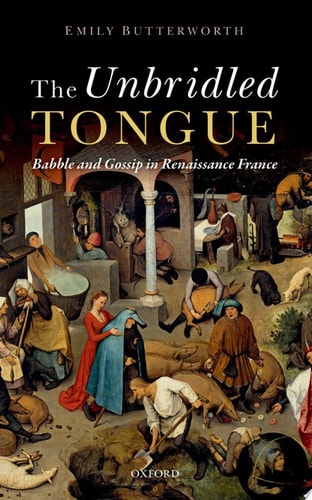
Unbridled Tongue: Babble and Gossip in Renaissance France
0
0
As an Amazon Associate and affiliate partner, Menrva Books earns from qualifying purchases. Learn more
Author Description
The Unbridled Tongue looks at gossip, rumor, and talking too much in Renaissance France in order to uncover what was specific about these practices in the period. Taking its cue from Erasmus's Lingua, in which both the subjective and political consequences of an idle and unbridled tongue are emphasized, the book investigates the impact of gossip and rumor on contemporary conceptions of identity and political engagement. Emily Butterworth discusses prescriptive literature on the tongue and theological discussions of Pentecost and prophecy, and then covers nearly a century in chapters focused on a single text: Rabelais's Tiers Livre, Marguerite de Navarre's Heptameron, Ronsard's Discours des miseres de ce temps, Montaigne's "Des boyteux," Brantome's Dames galantes and the anonymous Caquets de l'accouchee. In covering the "long sixteenth century," the book is able to investigate the impact of the French Wars of Religion on perceptions of gossip and rumor, and place them in the context of an emerging public sphere of political critique and discussion, principally through the figure of the "public voice" which, although it was associated with unruly utterance, was nevertheless a powerful rhetorical tool for the expression of grievances. The Cynic virtue of parrhesia, or free speech, is similarly ambivalent in many accounts, oscillating between bold truth-telling (liberte) and disordered babble (licence). Drawing on modern and pre-modern theories of the uses and function of gossip, the book argues that, despite this ambivalence in descriptions of the tongue, gossip, and idle talk were finally excluded from the public sphere by being associated with the feminine and the irrational.
Menrva's Summary
THE THESIS
This book investigates the cultural and political significance of gossip, rumor, and excessive speech in Renaissance France, questioning how these practices shaped early modern identity and public discourse. Emily Butterworth, a scholar of early modern French literature, utilizes a diverse range of primary sources—including theological texts, prescriptive literature, and seminal works by authors such as Rabelais and Montaigne—to construct her argument. She posits that while the 'public voice' served as a vital rhetorical tool for political critique during the French Wars of Religion, it was simultaneously marginalized through its association with irrationality and the feminine. By examining the tension between parrhesia and disordered babble, the author reveals how the period navigated the boundaries of acceptable speech.
THE SCOPE MAP
What You Will Find
- Analysis of the 'long sixteenth century' in France, specifically focusing on the impact of the French Wars of Religion.
- Close readings of canonical texts including Rabelais's Tiers Livre, Marguerite de Navarre's Heptameron, and Montaigne's essays.
- Integration of modern sociological theories of gossip alongside pre-modern theological and philosophical perspectives.
- Examination of the gendered exclusion of idle talk from the emerging public sphere.
THE AUTHORITY PERSPECTIVE
Scholars in the field of Renaissance studies identify this work as a rigorous examination of the intersection between rhetoric, politics, and social behavior. Readers frequently note the academic density of the prose, which provides a sophisticated framework for understanding the evolution of free speech and public discourse in early modern Europe.
Page Count:
256
Publication Date:
2016-04-11
Publisher:
Oxford University Press
ISBN-10:
0199662304
ISBN-13:
9780199662302
History
Literary Criticism
Sociology
French History
Cultural History
Community Tags
Similar Books