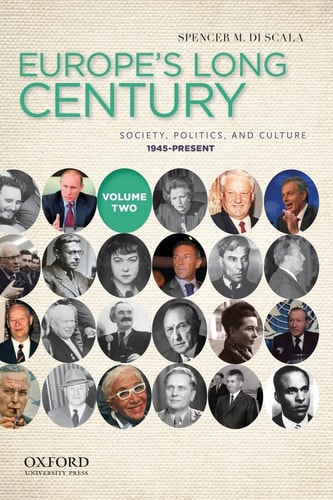
Europe's Long Century: Volume 2: 1945-Present: Society, Politics, and Culture
0
0
As an Amazon Associate and affiliate partner, Menrva Books earns from qualifying purchases. Learn more
Author Description
The twentieth century has been interpreted as a short century marked by extremes. According to this view, the century lasted only from 1914 to 1989 or 1991. These dates coincide with the rise and fall of communism that came to power in Russia in 1917 and ended with the fall of the Berlin wall (1989) or that of the Soviet Union (1991). Thus, the concept of a short century is unduly influenced by a Cold War perspective. In Europe's Long Century, Spencer Di Scala presents an alternative view that will be more helpful to undergraduate history students in the twenty-first-century: namely, that twentieth century Europe was actually a "long" century lasting approximately from 1900 to 2000 with patterns and antecedents discernible before the century began and that continue to be elaborated today.Comprehensive, current, and affordable, Europe's Long Century integrates the histories of Eastern Europe, Scandinavia, and the Balkans that are often neglected in similar treatments. It also thoroughly covers the role of science in shaping modern European life, and the book's "biographical sketches" profile the lives of important--though not always well known--people who influenced Europe's long century.
Menrva's Summary
THE THESIS
This volume investigates whether the twentieth century should be redefined as a 'long' century spanning from 1900 to 2000, rather than the traditional 'short' century defined by the Cold War. Professor Spencer M. Di Scala, a historian specializing in modern European politics, challenges the conventional 1914-1991 periodization. He argues that historical patterns and social developments possess deeper roots and longer trajectories that extend beyond the rise and fall of communism. By integrating diverse regional histories, he provides a framework for understanding the continuity of European evolution into the twenty-first century.
THE SCOPE MAP
What You Will Find
- Comprehensive coverage of post-1945 European political, social, and cultural developments.
- Integration of Eastern European, Scandinavian, and Balkan histories often omitted in standard texts.
- Biographical profiles of influential figures who shaped modern European life.
- Analysis of the role of scientific advancement in the evolution of European society.
THE AUTHORITY PERSPECTIVE
Experts identify this text as a valuable resource for undergraduate history students seeking a broader, more inclusive perspective on modern Europe. Readers frequently note the clarity of the prose and the effectiveness of the biographical sketches in humanizing complex historical shifts.
Page Count:
384
Publication Date:
2012-11-14
Publisher:
Oxford University Press
ISBN-10:
0199778523
ISBN-13:
9780199778522
History
European History
Europe biography
Social History
Cultural History
Modern History
Community Tags
Similar Books