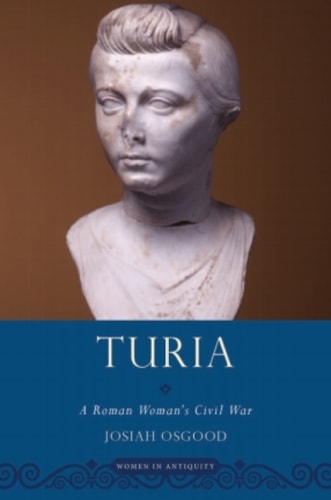
Turia: A Roman Woman's Civil War
0
0
As an Amazon Associate and affiliate partner, Menrva Books earns from qualifying purchases. Learn more
Author Description
The civil wars that brought down the Roman Republic were fought on more than battlefields. Armed gangs infested the Italian countryside, mansions were besieged in the city, and bounty-hunters searched the streets for "public enemies." Among the astonishing stories to survive from these years is that of a young woman whose parents were killed, on the eve of her wedding, in the violence engulfing Italy in the late first century BC. While her future husband fought overseas, she staved off a run on her father's estate and raised money to help her fiancé in exile. Further, when her husband, back in Rome, was declared an outlaw, she successfully hid him, worked for his pardon, and joined other Roman women in staging a public protest. The wife's tale is known only because her husband had inscribed on large slabs of marble the elaborate eulogy he gave at her funeral. In this book, Josiah Osgood reconstructs the life of Turia, as the wife is commonly known, more fully than it has been before by bringing in alongside the eulogy stories of other Roman women who also contributed to their families' survival while working to end civil war. He shows how the wife's story sheds rare light on the more hidden problems of everyday life for Romans, including a high number of childless marriages. This unique narrative is more than a biography of one woman: it is a portrait of a vivid period in Roman history and a tribute to married love which though from another world speaks to us today.
Menrva's Summary
THE THESIS
This book investigates the life of a Roman woman known as Turia to illuminate the domestic and political realities of the late Roman Republic's civil wars. Josiah Osgood, a scholar of Roman history, utilizes the primary source of the 'Laudatio Turiae'—a funerary eulogy inscribed on marble—to reconstruct the experiences of women during a period of extreme political instability. By contextualizing this specific account within the broader landscape of the era, Osgood argues that the actions of women were central to family survival and political negotiation during the collapse of the Republic.
THE SCOPE MAP
What You Will Find
- Analysis of the 'Laudatio Turiae' funerary inscription as a primary historical document.
- Examination of the socio-political impact of civil war on Roman households and estates.
- Comparative studies of other Roman women who navigated political exile and legal threats.
- Discussion of social issues in antiquity, including the prevalence of childless marriages and the dynamics of Roman marriage.
THE AUTHORITY PERSPECTIVE
Scholars and historians recognize this work as a significant contribution to the study of Roman social history and gender roles in antiquity. Readers frequently note the accessibility of the prose, which balances rigorous academic analysis with a compelling narrative approach to the available archaeological and textual evidence.
Page Count:
240
Publication Date:
2014-01-01
Publisher:
Oxford University Press
ISBN-10:
0199832382
ISBN-13:
9780199832385
Biography
History
Wives
Women biography
Ancient History
Rome biography
Marriage_rome
Biography Autobiography
English & College Success
Roman History
English
Women And War
Rome
Women rome
Community Tags
Similar Books