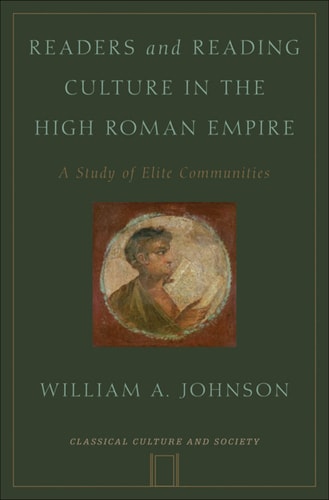
Readers and Reading Culture in the High Roman Empire: A Study of Elite Communities
0
0
As an Amazon Associate and affiliate partner, Menrva Books earns from qualifying purchases. Learn more
Author Description
In Readers and Reading Culture in the High Roman Empire, William Johnson examines the system and culture of reading among the elite in second-century Rome. The investigation proceeds in case-study fashion using the principal surviving witnesses, beginning with the communities of Pliny and Tacitus (with a look at Pliny's teacher, Quintilian) from the time of the emperor Trajan. Johnson then moves on to explore elite reading during the era of the Antonines, including the medical community around Galen, the philological community around Gellius and Fronto (with a look at the curious reading habits of Fronto's pupil Marcus Aurelius), and the intellectual communities lampooned by the satirist Lucian. Along the way, evidence from the papyri is deployed to help to understand better and more concretely both the mechanics of reading, and the social interactions that surrounded the ancient book. The result is a rich cultural history of individual reading communities that differentiate themselves in interesting ways even while in aggregate showing a coherent reading culture with fascinating similarities and contrasts to the reading culture of today.
Menrva's Summary
THE THESIS
How did the elite communities of the High Roman Empire engage with texts, and what does this reveal about their broader social and intellectual culture? William A. Johnson, a scholar of classical literature and papyrology, utilizes a combination of literary analysis and material evidence to reconstruct the reading habits of the second-century Roman elite. By examining the social circles surrounding figures like Pliny, Tacitus, Galen, and Marcus Aurelius, Johnson argues that reading was not a solitary act but a deeply communal and performative practice that defined social status and intellectual identity.
THE SCOPE MAP
What You Will Find
- Case studies of specific intellectual communities during the Trajanic and Antonine eras.
- Analysis of the mechanics of ancient reading, including the physical handling of scrolls and codices.
- Integration of papyrological evidence to supplement traditional literary sources.
- Exploration of the social interactions and status-signaling inherent in Roman reading culture.
THE AUTHORITY PERSPECTIVE
Scholars recognize this work as a significant contribution to the study of ancient literacy and the sociology of reading. Experts frequently highlight the author's effective synthesis of material papyrology with traditional textual analysis to provide a more nuanced understanding of the Roman intellectual landscape.
Page Count:
237
Publication Date:
2010-01-01
Publisher:
Oxford University Press
ISBN-10:
019988420X
ISBN-13:
9780199884209
History
Rome
English
Language Arts
Ancient History
Cultural History
English & College Success
Literary Criticism
Community Tags
Similar Books