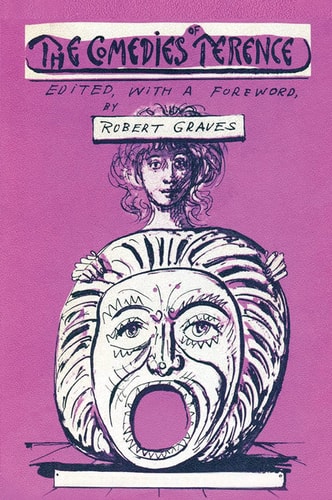
The Comedies of Terence
0
0
As an Amazon Associate and affiliate partner, Menrva Books earns from qualifying purchases. Learn more
Author Description
Terence achieved in his brief twenty-six years a standard of stylistic perfection and artistic restraint that ranked him, along with Plautus, as the greatest of the Roman comic playwrights. He was, at the very least, a gifted translator and adaptor, having used Greek New Comedies as the basis for all six of his extant plays. How far his own contribution exceeded that of simple translation is difficult to say, but we know that the Latin, undeniably his, was so faultlessly styled that his work served as a textbook for scholars and grammarians for hundreds of years.Terence had a considerable impact on the Revival of Letters; his comedies were studied and were frequently adapted into new works by such men as Steele, Chapman, and, most famously, Moliire. Indeed, had there been no Terence, it is doubtful that the Comedy of Manners could have arisen when it did, and all comic writing for the stage, from Moilire through the Restoration drama to the present day, would be diminished for lack of him. Appropriately, the language of this translation is from the Restoration. Graves has based his version on the one made in 1689 by Laurence Echard; he has corrected inaccuracies, eliminated defects and obscurities, but retained the period tone.Including in this book are the major comedies: The Fair Andrian, The Mother-In-Law, The Self-Tormentor, The Eunuch, The Tricks of Phormio and The Brothers. A close reading of Terence is a fine corrective to any idea that may still be current, about the glory that was Greece and grandeur that was Rome during the Hellenistic period. It is an assurance that in some respects at least, this age is not depraved at all.
Menrva's Summary
THE PULSE
The central conflict involves the intricate social maneuvering and domestic misunderstandings that define the lives of Roman citizens in Terence's classic comedies. These plays follow various protagonists as they navigate complex familial obligations, romantic entanglements, and the rigid expectations of their society. The narrative framework relies on the conventions of Roman New Comedy, utilizing stock characters and situational irony to expose the absurdities of human behavior. The characters must overcome their own deceptions and the interference of others to achieve resolution within a world governed by strict social hierarchies.
INSIDE THE PAGES
- Utilization of the Comedy of Manners structure to critique social norms.
- Employment of stock character archetypes including the clever slave and the stern father.
- Focus on domestic and romantic complications rather than political satire.
- Integration of witty dialogue and sophisticated linguistic precision.
- Exploration of themes such as generational conflict and the nature of virtue.
- Use of Restoration-era English prose to capture the original Latin tone.
- Structured plot resolutions that emphasize moral clarity and social harmony.
- Adaptation of Greek New Comedy source material into a distinct Roman context.
THE COLLECTIVE ECHO
Discussion often centers on the enduring influence of Terence's work on the development of Western comedic drama. Readers frequently highlight the accessibility of this specific translation, which retains a period-appropriate tone while correcting historical inaccuracies found in earlier versions. Critics often note the balance between the playwright's adherence to Greek source material and his unique stylistic contributions to Latin literature. The collection is widely regarded as a foundational text for understanding the evolution of the Comedy of Manners from the Roman period through the Restoration. Scholars emphasize that these plays provide a nuanced look at the social realities of the Hellenistic era, moving beyond idealized notions of antiquity.
Page Count:
348
Publication Date:
2009-01-15
Publisher:
Routledge
ISBN-10:
020236268X
ISBN-13:
9780202362687
Drama
Translation
Comedy
English drama
Terence
Classical
Roman
Plays
Community Tags
Other Editions(3)


Similar Books
Reader Comments
Share Your Thoughts
No comments yet. Be the first to share your thoughts!