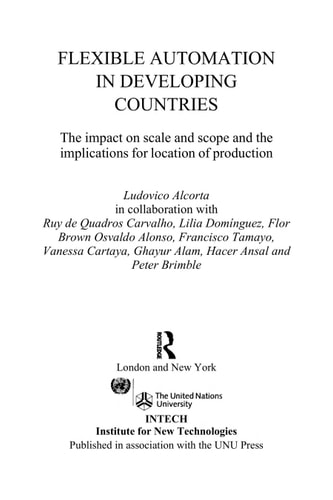
Flexible Automation in Developing Countries: The Impact on Scale and Scope and the Implications for Location of Production
0
0
As an Amazon Associate and affiliate partner, Menrva Books earns from qualifying purchases. Learn more
Author Description
This book examines the extent of, and motives for, the diffusion of flexible automation (FA) at global level and then turns to the local and firm level, bringing together in-depth studies of sixty-two firms in Brazil, India, Mexico, Thailand, Turkey and Venezuela. Research focuses on the impact of computer-numerically-controlled machine tools on scale and scope by exploring changes in lot sizes and product variety (product scale and scope), total plant output (plant scale) and total firm output (firm scale). Barriers to setting up FA-based operations are discussed, as are factors which may affect a decision to locate in a developing country. The contributed studies reveal a relatively slow diffusion of FA in developing countries and it is demonstrated that while FA possibly increases scope, it also requires that plant output be increased in order to maintain efficiency. Alcorta concludes that the location in developing countries will probably only be viable for large domestic firms, multinationals seeking to relocate simple but labour intensive assembly processes and firms in countries with significant domestic markets. This work is unique in addressing the scale and scope issues in developing countries and in the wealth of information regarding machine tools which it provides. The data provided in the appendix includes official United Nations data, previously unpublished. This will be of use for all research into trends in the use of machine tools.
Menrva's Summary
THE THESIS
This book investigates the diffusion of flexible automation (FA) in developing countries and its specific impact on production scale, scope, and global location strategies. Ludovico Alcorta utilizes a comparative framework based on empirical research from sixty-two firms across six developing nations. By analyzing the integration of computer-numerically-controlled machine tools, the author evaluates how these technologies alter production efficiency and firm-level output requirements. The study provides a rigorous assessment of the barriers to technological adoption and the economic conditions necessary for successful implementation in emerging markets.
THE SCOPE MAP
What You Will Find
- Comparative analysis of sixty-two firms across Brazil, India, Mexico, Thailand, Turkey, and Venezuela.
- Examination of production metrics including lot sizes, product variety, and total plant output.
- Primary data sets regarding machine tool trends, including previously unpublished United Nations statistics.
- Strategic assessment of factors influencing the location of manufacturing operations in developing economies.
THE AUTHORITY PERSPECTIVE
Experts recognize this work as a foundational empirical study for understanding the intersection of industrial automation and development economics. Researchers frequently cite the book for its detailed data appendix and its nuanced analysis of the limitations of flexible automation in non-industrialized contexts.
Page Count:
464
Publication Date:
1998-01-01
Publisher:
Routledge
ISBN-10:
0203193520
ISBN-13:
9780203193525
Economics
Automation
Manufacturing
Technology