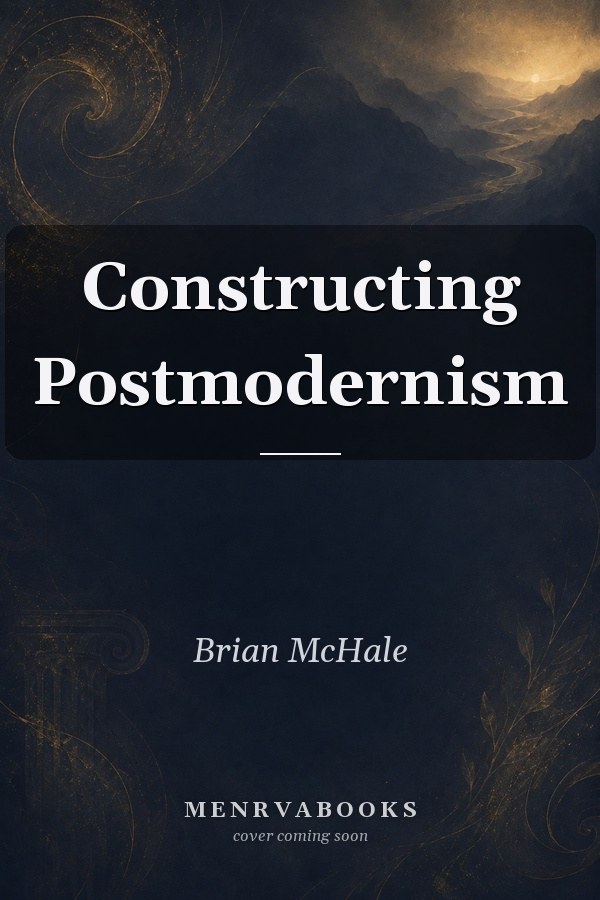
Constructing Postmodernism
0
0
As an Amazon Associate and affiliate partner, Menrva Books earns from qualifying purchases. Learn more
Author Description
Postmodernism is not a found object, but a manufactured artifact." Beginning from this constructivist premise, Brian McHale develops a series of readings of problematically postmodernist novelsJoyce's Ulysses; Pynchon's Gravity's Rainbow and Vineland; Eco's The Name of the Rose and Foucault's Pendulum; the novels of James McElroy and Christine Brooke-Rose, avant-garde works such as Kathy Aker's Empire of the Senseless, and works of cyberpunk science-fiction by William Gibson, Bruce Sterling, Lewis Shiner, Rudy Rucker, and others. Although mainly focused on "high" or "elite" cultural products, Constructing Postmodernism relates these products to such phenomena of postmodern popular culture as television and the cinema, paranoia and nuclear apocalypse, angelology and the cybernetic interface, and death, now as always, the true Final Frontier. McHale's previous book, Postmodernist Fiction (Routledge, 1987) seemed to propose a single, all-inclusive inventory of postmodernist poetics. This book, by contrast, proposes multiple, overlapping and intersecting inventoriesnot a construction of postmodernism, but a plurality of constructions.
Menrva's Summary
THE THESIS
This book investigates the core question of how postmodernism functions as a manufactured artifact rather than a static, pre-existing cultural object. Brian McHale, a prominent scholar in narrative theory, utilizes a constructivist framework to challenge the notion of a singular, all-inclusive definition of postmodernism. By analyzing a diverse range of texts, he argues that postmodernism is best understood as a plurality of overlapping and intersecting constructions rather than a unified poetics.
THE SCOPE MAP
What You Will Find
- Comparative analysis of high-culture novels by authors such as Pynchon, Eco, and Joyce alongside cyberpunk science fiction.
- Examination of cultural phenomena including paranoia, nuclear apocalypse, and the cybernetic interface.
- A methodological shift from the singular inventory approach of his previous work to a pluralistic model of postmodernist poetics.
- Theoretical exploration of the relationship between elite literature and popular media like television and cinema.
THE AUTHORITY PERSPECTIVE
Scholars and students of literary theory frequently cite this work as a vital counterpoint to McHale's earlier, more definitive studies on postmodernist fiction. Experts highlight the text for its sophisticated engagement with the fluidity of postmodern definitions and its ability to bridge the gap between avant-garde literature and popular culture.
Page Count:
356
Publication Date:
2012-01-01
Publisher:
Taylor & Francis Group
ISBN-10:
0203388593
ISBN-13:
9780203388594
Philosophy
Postmodernism
Literary Criticism
Science Fiction
Literary theory
Community Tags
Similar Books