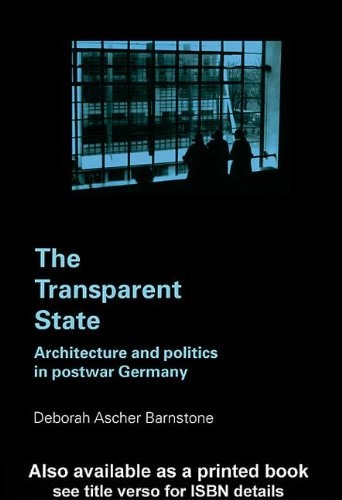
The Transparent State: Architecture and Politics in Postwar Germany
0
0
As an Amazon Associate and affiliate partner, Menrva Books earns from qualifying purchases. Learn more
Author Description
Examining the transformation of transparency as a metaphor in West German political thought to an analogy for democratic architecture, this book questions the prevailing assumption in German architectural circles that transparency in governmental buildings can be equated with openness, accessibility and greater democracy.The Transparent State traces the development of transparency in German political and architectural culture, tying this lineage to the relationship between culture and national identity, a connection that began before unification of the German state in the eighteenth century and continues today. The Weimar Republic and Third Reich periods are examined although the focus is on the postwar period, looking at the use of transparency in the three projects for a national parliament - the 1949 Bundestag project by Hans Schwippert, the 1992 Bundestag building by Gunter Behnisch and the 1999 Reichstag renovation by Norman Foster.Transparency is an important issue in contemporary architectural practice; this book will appeal to both the practising architect and the architectural historian.
Menrva's Summary
THE THESIS
This book investigates whether the architectural use of transparency in government buildings effectively translates into political openness and democratic accessibility within the context of postwar Germany. Deborah Ascher Barnstone, an architectural historian, challenges the long-standing assumption that glass-heavy, transparent design inherently fosters democratic values. By analyzing the historical evolution of transparency as both a political metaphor and an architectural strategy, the author provides a critical framework for understanding how national identity is constructed through the built environment.
THE SCOPE MAP
What You Will Find
- A historical analysis of the relationship between German national identity and architectural culture from the eighteenth century to the present.
- A comparative study of three major parliamentary projects: the 1949 Bundestag by Hans Schwippert, the 1992 Bundestag by Gunter Behnisch, and the 1999 Reichstag renovation by Norman Foster.
- An examination of the ideological shifts in the Weimar Republic and the Third Reich regarding public space and state representation.
- A critical methodology for evaluating the intersection of political theory and structural design in modern government facilities.
THE AUTHORITY PERSPECTIVE
Experts and architectural historians recognize this work as a significant contribution to the study of German political architecture. Readers frequently note the academic density of the prose, which serves as a foundational text for those interested in the intersection of design, history, and statecraft.
Page Count:
304
Publication Date:
2004-11-30
Publisher:
Routledge
ISBN-10:
0203799887
ISBN-13:
9780203799888
History
Architecture
Transparency in architecture
Transparency in government
German history
Public buildings
urban planning