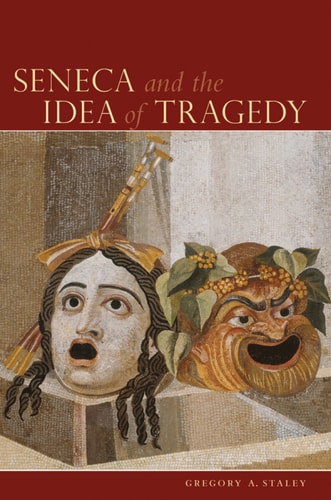
Seneca and the Idea of Tragedy
0
0
As an Amazon Associate and affiliate partner, Menrva Books earns from qualifying purchases. Learn more
Author Description
As both a literary genre and a view of life, tragedy has from the very beginning spurred a dialogue between poetry and philosophy. Plato famously banned tragedians from his ideal community because he believed that their representations of vicious behavior could deform minds. Aristotle set out to answer Plato's objections, arguing that fiction offers a faithful image of the truth and that it promotes emotional health through the mechanism of catharsis. Aristotle's definition of tragedy actually had its greatest impact not on Greek tragedy itself but on later Latin literature, beginning with the tragedies of the Roman poet and Stoic philosopher Seneca (4 BC - AD 65). Scholarship over the last fifty years, however, has increasingly sought to identify in Seneca's prose writings a Platonic poetics which is antagonistic toward tragedy and which might therefore explain why Seneca's plays seem so often to present the failure of Stoicism. As Gregory Staley argues in this book, when Senecan tragedy fails to stage virtue we should see in this not the failure of Stoicism but a Stoic conception of tragedy as the right vehicle for imaging Seneca's familiar world of madmen and fools. Senecan tragedy enacts Aristotle's conception of the genre as a vivid image of the truth and treats tragedy as a natural venue in which to explore the human soul. Staley's reading of Seneca's plays draws on current scholarship about Stoicism as well as on the writings of Renaissance authors like Sir Philip Sidney, who borrowed from Seneca the word "idea" to designate what we would now label as a "theory" of tragedy. Seneca and the Idea of Tragedy will appeal broadly to students and scholars of classics, ancient philosophy, and English literature.
Menrva's Summary
THE THESIS
This book investigates the core question of how Seneca’s tragedies function as a philosophical vehicle for exploring the human soul and the nature of truth. Gregory A. Staley, a scholar of classical literature, examines the tension between Seneca's Stoic prose and his dramatic works. He argues that rather than representing a failure of Stoic philosophy, Seneca’s plays utilize the genre of tragedy to accurately depict a world populated by irrationality and moral struggle.
THE SCOPE MAP
What You Will Find
- Analysis of the intersection between Platonic poetics and Aristotelian definitions of tragedy
- Examination of Seneca’s plays as a medium for Stoic inquiry
- Integration of Renaissance literary theory, specifically the work of Sir Philip Sidney
- Comparative study of Seneca’s prose versus his dramatic output
Scope Limits
- The text focuses primarily on the Roman context and subsequent influence on Renaissance theory rather than a comprehensive history of all Greek tragedy.
THE AUTHORITY PERSPECTIVE
Scholars and students of classics and philosophy view this work as a significant contribution to the understanding of Senecan drama. The text is noted for its ability to bridge the gap between ancient philosophical doctrine and the practical application of literary theory.
Page Count:
198
Publication Date:
2009-01-01
Publisher:
Oxford University Press
ISBN-10:
0190452706
ISBN-13:
9780190452704
Classics
Philosophy
History
Drama
Tragedy
History & Surveys
Literary Criticism
Community Tags
Other Editions(3)

Similar Books
Reader Comments
Share Your Thoughts
No comments yet. Be the first to share your thoughts!