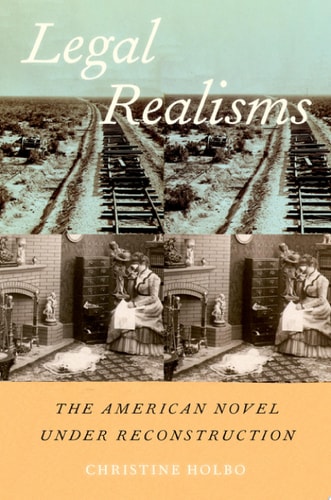
Legal Realisms
0
0
As an Amazon Associate and affiliate partner, Menrva Books earns from qualifying purchases. Learn more
Author Description
United States Historians Have Long Regarded The U.s. Civil War And Its Reconstruction As A Second American Revolution. Literary Scholars, However, Have Yet To Show How Fully These Years Revolutionized The American Imagination. Emblematic Of This Moment Was The Post-war Search For A Great American Novel--a Novel Fully Adequate To The Breadth And Diversity Of The United States In The Era Of The Fourteenth Amendment. While The Passage Of The Reconstruction Amendments Declared The Ideal Of Equality Before The Law A Reality, Persistent And Increasing Inequality Challenged Idealists And Realists Alike. The Controversy Over What Full Representation Should Mean Sparked Debates About The Value Of Cultural Difference And Aesthetic Dissonance, And It Led To A Thoroughgoing Reconstruction Of The Meaning Of Realism For Readers, Writers, Politics, And Law. The Dilemmas Of Incomplete Emancipation, Which Would Damage And Define American Life From The Late Nineteenth Century Onwards, Would Also Force Novelists To Reconsider The Definition And Possibilities Of The Novel As A Genre Of Social Representation. Legal Realisms Examines These Transformations In The Face Of Uneven Developments In The Racial, Ethnic, Gender And Class Structure Of American Society. Offering Provocative New Readings Of Mark Twain, Henry James, William Dean Howells, Helen Hunt Jackson, Albion Tourgée And Others, Christine Holbo Explores The Transformation Of The Novel's Distinctive Modes Of Social Knowledge In Relation To Developments In Art, Philosophy, Law, Politics, And Moral Theory. As Legal Realisms Follows The Novel Through The Worlds Of California Native American Removal And The Reconstruction-era South, Of The Mississippi Valley And The Urban Northeast, This Study Shows How Violence, Prejudice, And Exclusion Haunted The Celebratory Literatures Of National Equality, But It Demonstrates As Well The Way Novelists' Representation Of The Difficulty Of Achieving Equality Before The Law Helped Americans Articul
Menrva's Summary
THE THESIS
This study investigates how the American novel was fundamentally reconstructed in the post-Civil War era to address the complex relationship between legal ideals and social inequality. Christine Holbo, an academic scholar, utilizes a multidisciplinary approach to analyze how the shift toward realism in literature mirrored the evolving legal and political landscape following the Reconstruction Amendments. The work argues that novelists of the period were forced to redefine the novel as a tool for social representation while grappling with the persistent failures of emancipation and the realities of racial, ethnic, and class-based exclusion.
THE SCOPE MAP
What You Will Find
- Analysis of the intersection between 19th-century legal theory and literary realism.
- Critical readings of authors including Mark Twain, Henry James, William Dean Howells, Helen Hunt Jackson, and Albion Tourgée.
- Examination of diverse geographic and social contexts, from California Native American removal to the Reconstruction-era South and the urban Northeast.
Scope Limits
- The study focuses primarily on the late nineteenth century and does not extend its analysis into twentieth-century legal or literary developments.
- The text prioritizes the relationship between law and literature over a comprehensive history of the Reconstruction era itself.
THE AUTHORITY PERSPECTIVE
Scholars and critics recognize this work as a significant contribution to the study of American literary history and its entanglement with legal philosophy. Readers frequently note the academic density of the prose, which is intended for an audience familiar with both literary theory and historical legal discourse.
Page Count:
384
Publication Date:
2019-01-01
Publisher:
Oxford University Press
ISBN-10:
0190604557
ISBN-13:
9780190604554
19th Century
American History
Legal Studies
Literary Criticism
Community Tags
Similar Books