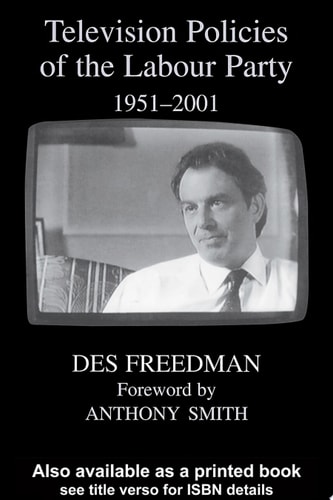
Television Policies of the Labour Party 1951-2001
0
0
As an Amazon Associate and affiliate partner, Menrva Books earns from qualifying purchases. Learn more
Author Description
Des Freedman explores Labour's divided response to the development of commercial television in the 1950s and assesses the impact of Wilson's governments on television in the 1960s. His key argument is that Labour has always been a vigorous but ultimately unreliable advocate of television.
Menrva's Summary
THE THESIS
This book investigates the Labour Party's complex and often contradictory relationship with television policy from the post-war era to the turn of the millennium. Des Freedman, drawing on extensive historical research, argues that while Labour consistently championed public service broadcasting and sought to regulate the burgeoning commercial television sector, its commitment wavered and its effectiveness was ultimately undermined by internal divisions and shifting political priorities. The analysis traces this evolution through key periods, including the initial debates over commercial television, the impact of the Wilson governments, and the party's response to the challenges of deregulation and privatization in later decades.
THE SCOPE MAP
- An examination of the Labour Party's response to the development of commercial television in the 1950s.
- An assessment of the impact of Harold Wilson's governments on television policy in the 1960s.
- Analysis of Labour's evolving stance on public service broadcasting versus commercial interests.
- Exploration of the party's approach to television regulation and privatization.
- A historical overview of Labour's advocacy for television from 1951 to 2001.
THE AUTHORITY PERSPECTIVE
The book is likely to be of interest to scholars and students of media history, political science, and British cultural studies. Its focus on a specific political party's engagement with a key communication technology offers a detailed case study. The argument that Labour was a 'vigorous but ultimately unreliable advocate' suggests a critical perspective on the party's historical policies. The analysis of Labour's divided response to commercial television and the impact of its governments provides a nuanced historical account.
Page Count:
224
Publication Date:
2004-08-02
Publisher:
Routledge
ISBN-10:
1135759243
ISBN-13:
9781135759247
Politics
History
Non-Fiction
Television broadcasting
Media Studies
Community Tags
Other Editions(3)

Similar Books