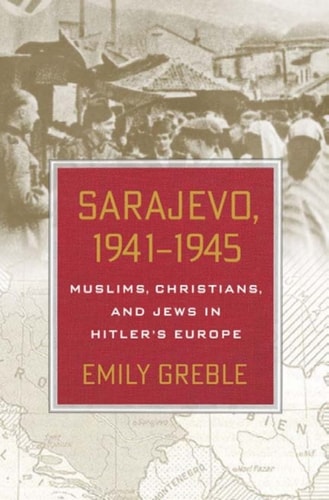
Sarajevo, 1941–1945
0
0
As an Amazon Associate and affiliate partner, Menrva Books earns from qualifying purchases. Learn more
Author Description
There is much to commend this study. Emily Greble capitalizes on a recent historiographical trend which prioritizes the local to observe the national and international.... Greble has contributed an important study which should be useful to others researching the war years in the region. ― Journal of Jewish Studies On April 15, 1941, Sarajevo fell to Germany’s 16th Motorized Infantry Division. The city, along with the rest of Bosnia, was incorporated into the Independent State of Croatia, one of the most brutal of Nazi satellite states run by the ultranationalist Croat Ustasha regime. The occupation posed an extraordinary set of challenges to Sarajevo’s famously cosmopolitan culture and its civic consciousness; these challenges included humanitarian and political crises and tensions of national identity. As detailed for the first time in Emily Greble’s book, the city’s complex mosaic of confessions (Catholic, Orthodox, Muslim, Jewish) and ethnicities (Croat, Serb, Jew, Bosnian Muslim, Roma, and various other national minorities) began to fracture under the Ustasha regime’s violent assault on "Serbs, Jews, and Roma"—contested categories of identity in this multiconfessional space—tearing at the city’s most basic traditions. Nor was there unanimity within the various ethnic and confessional groups: some Catholic Croats detested the Ustasha regime while others rode to power within it; Muslims quarreled about how best to position themselves for the postwar world, and some cast their lot with Hitler and joined the ill-fated Muslim Waffen SS. In time, these centripetal forces were complicated by the Yugoslav civil war, a multisided civil conflict fought among Communist Partisans, Chetniks (Serb nationalists), Ustashas, and a host of other smaller groups. The absence of military conflict in Sarajevo allows Greble to explore the different sides of civil conflict, shedding light on the way
Menrva's Summary
THE THESIS
This book investigates the profound impact of the German occupation and the ensuing civil war on Sarajevo's complex, cosmopolitan identity between 1941 and 1945. Emily Greble, leveraging a recent historiographical focus on local dynamics, examines how the city's diverse religious and ethnic fabric—Catholic, Orthodox, Muslim, Jewish, Croat, Serb, Roma—was strained and fractured by the brutal Ustasha regime and the multi-sided Yugoslav civil conflict. The study details the internal divisions within these groups and the contested nature of identities under extreme pressure.
THE SCOPE MAP
- The fall of Sarajevo to the German 16th Motorized Infantry Division on April 15, 1941.
- The incorporation of Sarajevo into the Independent State of Croatia under the Ustasha regime.
- The challenges posed to Sarajevo's cosmopolitan culture and civic consciousness, including humanitarian and political crises.
- The fracturing of the city's mosaic of confessions and ethnicities under the Ustasha regime's violent assault.
- Internal divisions within Catholic Croats, Muslims, and other groups regarding the Ustasha regime and postwar positioning.
- The complicating factors of the Yugoslav civil war, involving Communist Partisans, Chetniks, Ustashas, and other factions.
- An exploration of civil conflict dynamics through the lens of Sarajevo's relative absence of direct military engagement.
THE AUTHORITY PERSPECTIVE
The book is commended for its detailed study of the local impact of the war years in the region, capitalizing on recent historiographical trends that prioritize local observation to understand national and international events. Reviewers note its contribution to research on the war years, highlighting its exploration of the challenges to Sarajevo's cosmopolitan culture and civic consciousness. The study is recognized for its in-depth examination of the city's complex mosaic of confessions and ethnicities under the violent assault of the Ustasha regime. It is considered a useful resource for those researching the period.
Page Count:
296
Publication Date:
2011-02-25
Publisher:
Cornell University Press
ISBN-10:
0801460735
ISBN-13:
9780801460739
History
Non-Fiction
Cultural History
National Identity
Community Tags
Similar Books