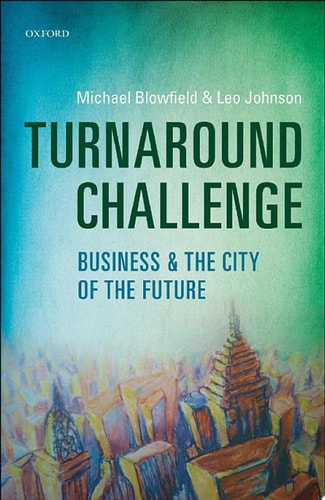
Turnaround Challenge: Business and the City of the Future
0
0
As an Amazon Associate and affiliate partner, Menrva Books earns from qualifying purchases. Learn more
Author Description
Do we have the rights to optimism? Can capitalism deliver a next great wave of growth? The future, wrote William Gibson, is already here. It just isn't evenly distributed yet. Lucid and polemical, Turnaround Challenge is a dig into that future and its meaning for business. It dissects the nexus of social, economic, environmental and governance crises confronting us, and a series of colliding megatrends with the potential to reshape opportunities for growth. Three cities of the future are emerging. The first is Petropolis, the alluringly familiar but decreasingly resilient city, locked into the century old technologies of fossil fuel-driven mass production. This is the city of rising inequality, credit-fuelled consumption, offshored jobs, climate volatility, and unsustainable household and national debt. The second city is Cyburbia. This is mass production on the steroids of IT: the latest manifestation of science fictions city without pain, but one inhabited by voice-activated popcorn dispensers, of athletics' shoes with in-built Twitter feeds, of sensor-packed and censoring glass towers that risk reducing their citizens to digital factors of production in the supply chain of big data. The third is the Distributed City, where technology is deployed with the intent to connect us not virtually but physically--from Nairobi's network of innovation spaces to Hamburg's Participatory Budgeting experiments, from Barcelona's network for micro-manufacturing, to Austin's distributed smart grid. These are the cities of society's future, and they have very different implications for business success, and our ability to navigate the social, economic, and environmental megatrends that confront us. Blowfield and Johnson present the DNA of the winners of the future, high growth and disruptive businesses, emerging from the bottom up, and with the capacity to tackle society's biggest challenges head on.
Menrva's Summary
THE THESIS
Can modern capitalism evolve to address the converging social, economic, and environmental crises of the twenty-first century? Leo Johnson and Michael Blowfield, both experts in sustainability and business strategy, analyze the current trajectory of global markets to determine if existing growth models are viable. They argue that businesses must pivot away from outdated industrial paradigms toward decentralized, socially conscious models to remain relevant and successful in an increasingly volatile world.
THE SCOPE MAP
What You Will Find
- Analysis of three distinct urban models: Petropolis, Cyburbia, and the Distributed City.
- Examination of global megatrends including climate volatility, debt, and big data integration.
- Case studies of innovation hubs ranging from Nairobi to Hamburg and Austin.
- Frameworks for identifying high-growth, disruptive business models that prioritize societal impact.
Scope Limits
- The text does not provide a comprehensive manual for individual corporate management or internal HR policy.
- It does not offer a predictive timeline for the collapse or success of specific national economies.
THE AUTHORITY PERSPECTIVE
Experts and readers often describe this work as a provocative synthesis of urban planning and corporate strategy that challenges traditional growth metrics. The text is frequently cited by professionals in sustainability and business development for its clear articulation of the risks inherent in current technological and economic trends.
Page Count:
262
Publication Date:
2013-01-01
Publisher:
OUP Oxford
ISBN-10:
0191009342
ISBN-13:
9780191009341
Business
Economics
Sustainability
Future Studies
urban planning
Technology
Community Tags
Other Editions(2)

Similar Books





Reader Comments
Share Your Thoughts
No comments yet. Be the first to share your thoughts!