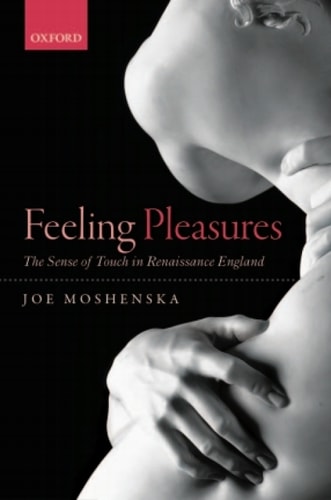
Feeling Pleasures: The Sense of Touch in Renaissance England
0
0
As an Amazon Associate and affiliate partner, Menrva Books earns from qualifying purchases. Learn more
Author Description
The sense of touch had a deeply uncertain status in the sixteenth and seventeenth centuries. It had long been seen as the most certain and reliable of the senses, and also as biologically necessary: each of the other senses could be relinquished, but to lose touch was to lose life itself. Alternatively, touch was seen as dangerously bodily, and too fully involved in sensual and sexual pleasures, to be of true worth. Feeling Pleasures argues that this tension came to the fore during the English Renaissance, and allowed some of the central debates of this period--surrounding the nature of human experience, of the material world, and of the relationship between the human and the divine--to proceed through discussions of touch. It also argues that the unstable status of touch was of particular import to the poetry of this period. By bringing touch to the fore in a period usually associated with the dominance of vision and optics, Joe Moshenska offers reconsiderations of major English poets, especially Edmund Spenser and John Milton, while exploring a range of spheres in which touch assumed new significance. These include theological debates surrounding relics and the Eucharist in the work of Erasmus, Thomas Cranmer and Lancelot Andrewes; the philosophical history of tickling; the touching of paintings and sculptures in a European context; faith healing and experimental science; and the early reception of Chinese medicine in England.
Menrva's Summary
THE THESIS
This book investigates how the sense of touch functioned as a critical site of tension and philosophical inquiry in Renaissance England. Joe Moshenska, a scholar of early modern literature, utilizes a combination of theological texts, philosophical treatises, and poetic analysis to argue that touch was central to understanding the material world and the human condition. By challenging the traditional scholarly focus on vision and optics, the author demonstrates how touch mediated debates regarding the divine, the body, and scientific experimentation.
THE SCOPE MAP
What You Will Find
- Analysis of touch in the poetry of Edmund Spenser and John Milton
- Examination of theological controversies involving relics and the Eucharist
- Historical exploration of the philosophy of tickling and early medical practices
- Case studies on the physical interaction with art and the reception of Chinese medicine
Scope Limits
- The study is primarily confined to the intellectual and cultural landscape of sixteenth and seventeenth-century England
- It does not provide a comprehensive history of sensory perception across all global cultures
THE AUTHORITY PERSPECTIVE
Scholars recognize this work as a significant contribution to sensory history and early modern literary studies. Readers frequently note the academic density of the prose and the author's ability to synthesize diverse historical sources into a cohesive argument.
Page Count:
408
Publication Date:
2014-01-01
Publisher:
OUP Oxford
ISBN-10:
0191022039
ISBN-13:
9780191022036
Philosophy
History
Cultural History
Literary Criticism
English poetry
English
English & College Success
Community Tags
Similar Books