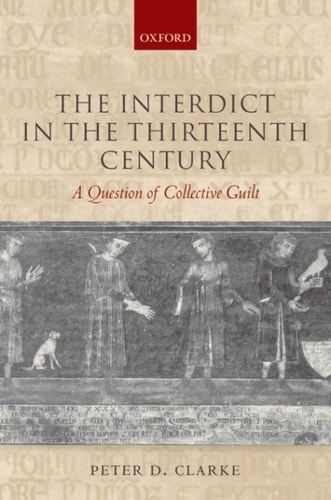
The Interdict in the Thirteenth Century: A Question of Collective Guilt
0
0
As an Amazon Associate and affiliate partner, Menrva Books earns from qualifying purchases. Learn more
Author Description
The interdict was an important and frequent event in medieval society. It was an ecclesiastical sanction which had the effect of closing churches and suspending religious services. Often imposed on an entire community because its leaders had violated the rights and laws of the Church, popes exploited it as a political weapon in their conflicts with secular rulers during the thirteenth century. In this book, Peter Clarke examines this significant but neglected subject, presenting a wealth of new evidence drawn from manuscripts and archival sources. He begins by exploring the basic legal and moral problem raised by the interdict: how could a sanction that punished many for the sins of the few be justified? From the twelfth-century, jurists and theologians argued that those who consented to the crimes of others shared in the responsibility and punishment for them. Hence important questions are raised about medieval ideas of community, especially about the relationship between its head and members. The book goes on to explore how the interdict was meant to work according to the medieval canonists, and how it actually worked in practice. In particular it examines princely and popular reactions to interdicts and how these encouraged the papacy to reform the sanction in order to make it more effective. Evidence including detailed case-studies of the interdict in action, is drawn from across thirteenth-century Europe - a time when the papacy's legislative activity and interference in the affairs of secular rulers were at their height.
Menrva's Summary
THE THESIS
This book investigates the moral and legal justification for the medieval interdict, a sanction that punished entire communities for the actions of their leaders. Peter D. Clarke, a specialist in medieval ecclesiastical history, utilizes a vast array of primary source material, including manuscripts and archival records, to analyze the intersection of canon law and political conflict. He argues that the evolution of the interdict reflects shifting medieval concepts of collective responsibility and the complex power dynamics between the papacy and secular rulers.
THE SCOPE MAP
What You Will Find
- Analysis of thirteenth-century canon law regarding collective guilt and corporate responsibility.
- Examination of the practical application of interdicts across Europe.
- Detailed case studies of conflicts between popes and secular authorities.
- Discussion of the theological justifications for punishing communities for the sins of their leaders.
Scope Limits
- The study focuses primarily on the thirteenth century and does not provide an exhaustive history of the interdict in other eras.
- The analysis is centered on ecclesiastical and legal frameworks rather than the daily lived experience of the common laity.
THE AUTHORITY PERSPECTIVE
Scholars recognize this work as a definitive study on the mechanics and moral implications of the medieval interdict. Readers frequently note the academic density of the prose and the precision with which Clarke handles complex legal and theological source material.
Page Count:
320
Publication Date:
2007-01-01
Publisher:
Oxford University Press
ISBN-10:
0191526061
ISBN-13:
9780191526060
Religion
History
Ecclesiastical History
Canon law
Political History
Guilt Law
European History
Community Tags
Similar Books