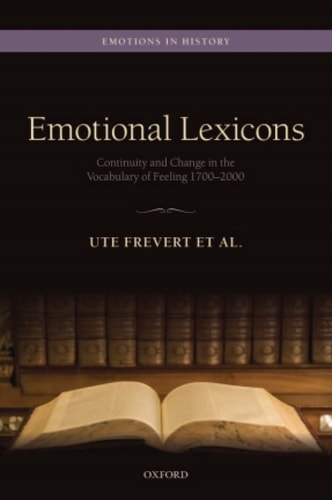
Emotional Lexicons: Continuity and Change in the Vocabulary of Feeling 1700-2000
0
0
As an Amazon Associate and affiliate partner, Menrva Books earns from qualifying purchases. Learn more
Author Description
Emotions are as old as humankind. But what do we know about them and what importance do we assign to them? Emotional Lexicons is the first cultural history of terms of emotion found in German, French, and English language encyclopaedias since the late seventeenth century. Insofar as these reference works formulated normative concepts, they documented shifts in the way the educated middle classes were taught to conceptualise emotion by a literary medium targeted specifically to them. As well as providing a record of changing language use (and the surrounding debates), many encyclopaedia articles went further than simply providing basic knowledge; they also presented a moral vision to their readers and guidelines for behaviour. Implicitly or explicitly, they participated in fundamental discussions on human nature: Are emotions in the mind or in the body? Can we "read" another person's feelings in their face? Do animals have feelings? Are men less emotional than women? Are there differences between the emotions of children and adults? Can emotions be "civilised"? Can they make us sick? Do groups feel together? Do our emotions connect us with others or create distance? The answers to these questions are historically contingent, showing that emotional knowledge was and still is closely linked to the social, cultural, and political structures of modern societies. Emotional Lexicons analyses European discourses in science, as well as in broader society, about affects, passions, sentiments, and emotions. It does not presume to refine our understanding of what emotions actually are, but rather to present the spectrum of knowledge about emotion embodied in concepts whose meanings shift through time, in order to enrich our own concept of emotion and to lend nuances to the interdisciplinary conversation about them.
Menrva's Summary
THE THESIS
This book investigates how the conceptualization of human emotion has evolved within European encyclopedic discourse from the late seventeenth century to the year 2000. The authors, a collaborative team of historians led by Ute Frevert, utilize a comparative analysis of German, French, and English reference works to map the shifting vocabulary of feeling. They argue that these lexicons did not merely record definitions but actively constructed normative frameworks for behavior and moral understanding among the educated middle classes.
THE SCOPE MAP
What You Will Find
- A comparative study of encyclopedic entries across three languages: German, French, and English.
- An analysis of the intersection between scientific discourse and societal norms regarding affect.
- Examination of thematic questions such as the mind-body connection, gendered emotionality, and the civilizing process of feelings.
Scope Limits
- The study focuses primarily on the educated middle-class perspective as represented in formal reference literature.
- It does not attempt to define the biological or psychological reality of emotions, focusing instead on the history of the concepts themselves.
THE AUTHORITY PERSPECTIVE
Scholars in the field of the history of emotions recognize this work as a foundational text for understanding how language shapes our perception of internal states. Readers frequently note the academic density of the prose, which serves as a rigorous resource for historians and sociologists interested in the evolution of cultural norms.
Page Count:
304
Publication Date:
2014-01-01
Publisher:
OUP Oxford
ISBN-10:
0191667420
ISBN-13:
9780191667428
History
Sociology
History of Emotions
Linguistics
Cultural History
European History
Community Tags
Similar Books



Reader Comments
Share Your Thoughts
No comments yet. Be the first to share your thoughts!