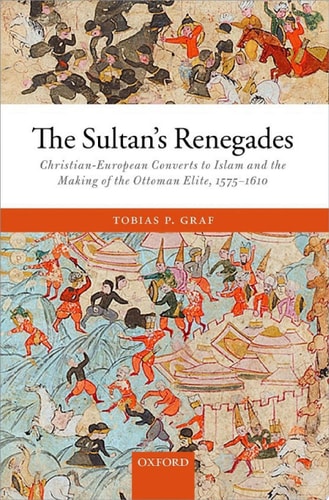
The Sultan's Renegades: Christian-European Converts to Islam and the Making of the Ottoman Elite, 1575-1610
0
0
As an Amazon Associate and affiliate partner, Menrva Books earns from qualifying purchases. Learn more
Author Description
The figure of the renegade - a European Christian or Jew who had converted to Islam and was now serving the Ottoman sultan - is omnipresent in all genres produced by those early modern Christian Europeans who wrote about the Ottoman Empire. As few contemporaries failed to remark, converts were disproportionately represented among those who governed, administered, and fought for the sultan. Unsurprisingly, therefore, renegades have attracted considerable attention from historians of Europe as well as students of European literature. Until very recently, however, Ottomanists have been surprisingly silent on the presence of Christian-European converts in the Ottoman military-administrative elite. The Sultan's Renegades inserts these 'foreign' converts into the context of Ottoman elite life to reorient the discussion of these individuals away from the present focus on their exceptionality, towards a qualified appreciation of their place in the Ottoman imperial enterprise and the Empire's relations with its neighbours in Christian Europe. Drawing heavily on Central European sources, this study highlights the deep political, religious, and cultural entanglements between the Ottoman Empire and Christian Europe beyond the Mediterranean Basin as the 'shared world' par excellence. The existence of such trans-imperial subjects is not only symptomatic of the Empire's ability to attract and integrate people of a great diversity of backgrounds, it also illustrates the extent to which the Ottomans participated in processes of religious polarization usually considered typical of Christian Europe in this period. Nevertheless, Christian Europeans remained ambivalent about those they dismissed as apostates and traitors, frequently relying on them for support in the pursuit of familial and political interests.
Menrva's Summary
THE THESIS
This study investigates the role and integration of Christian-European converts to Islam within the Ottoman military-administrative elite between 1575 and 1610. Tobias P. Graf, a scholar of early modern history, utilizes a wealth of Central European archival sources to challenge the traditional view of these converts as mere anomalies. He argues that these individuals were integral to the Ottoman imperial project and served as key nodes in the complex political and cultural entanglements between the Ottoman Empire and Christian Europe.
THE SCOPE MAP
What You Will Find
- Analysis of the socio-political integration of converts into the Ottoman governing structure.
- Examination of trans-imperial networks spanning beyond the Mediterranean Basin.
- Investigation into the religious polarization processes within the Ottoman context.
Scope Limits
- The study focuses specifically on the period between 1575 and 1610.
- It does not provide a comprehensive history of all converts throughout the entire duration of the Ottoman Empire.
THE AUTHORITY PERSPECTIVE
Historians recognize this work as a significant contribution to Ottoman studies for its shift away from viewing converts as exceptional figures. Scholars frequently highlight the book's rigorous use of Central European sources to illuminate the nuanced relationship between the Ottoman Empire and its neighbors.
Page Count:
285
Publication Date:
2017-01-01
Publisher:
OUP Oxford
ISBN-10:
0192509047
ISBN-13:
9780192509048
History
Middle East
Middle Eastern
Political History
Ottoman Empire
Cultural History
History - Modern
Community Tags
Similar Books