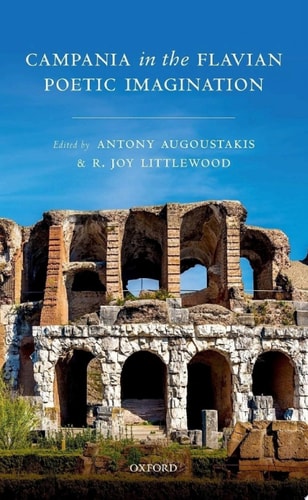
Campania in the Flavian Poetic Imagination
0
0
As an Amazon Associate and affiliate partner, Menrva Books earns from qualifying purchases. Learn more
Author Description
The region of Campania with its fertility and volcanic landscape exercised great influence over the Roman cultural imagination. A hub of activity outside the city of Rome, the Bay of Naples was a place of otium, leisure and quiet, repose and literary productivity, and yet also a place of danger: the looming Vesuvius inspired both fear and awe in the region's inhabitants, while the Phlegraean Fields evoked the story of the gigantomachy and sulphurous lakes invited entry to the Underworld. For Flavian writers in particular, Campania became a locus for literary activity and geographical disaster when in 79 CE, the eruption of the volcano annihilated a great expanse of the region, burying under a mass of ash and lava the surrounding cities of Pompeii, Herculaneum, and Stabiae. In the aftermath of such tragedy the writers examined in this volume - Martial, Silius Italicus, Statius, and Valerius Flaccus - continued to live, work, and write about Campania, which emerges from their work as an alluring region held in the balance of luxury and peril.
Menrva's Summary
THE THESIS
This volume investigates how the landscape of Campania, characterized by both its fertility and the looming threat of Vesuvius, shaped the literary output of Flavian-era Roman poets. The editors, Antony Augoustakis and R. Joy Littlewood, curate a collection of scholarly essays that analyze how authors such as Martial, Silius Italicus, Statius, and Valerius Flaccus navigated the tension between the region's reputation as a site of leisure and its reality as a site of catastrophic geological destruction. The work provides a framework for understanding the intersection of geography, trauma, and creative production in the aftermath of the 79 CE eruption.
THE SCOPE MAP
What You Will Find
- Analysis of Flavian literary responses to the eruption of Vesuvius.
- Examination of the cultural dichotomy between Campania as a place of otium and a place of peril.
- Scholarly exploration of the mythological significance of the Phlegraean Fields.
Scope Limits
- The volume focuses specifically on the Flavian period and does not provide a comprehensive history of the region across all Roman eras.
- The text is limited to the literary perspective and does not function as an archaeological report on the buried cities.
THE AUTHORITY PERSPECTIVE
Scholars and classicists recognize this collection as a significant contribution to the study of Flavian literature and its engagement with the physical environment. Readers frequently note the academic density of the prose, which is intended for an audience familiar with Latin literature and Roman history.
Page Count:
352
Publication Date:
2019-01-01
Publisher:
OUP Oxford
ISBN-10:
0192534831
ISBN-13:
9780192534835
History
Poetry
English
Literary Criticism
Geography
English & College Success
Roman History
Community Tags
Similar Books