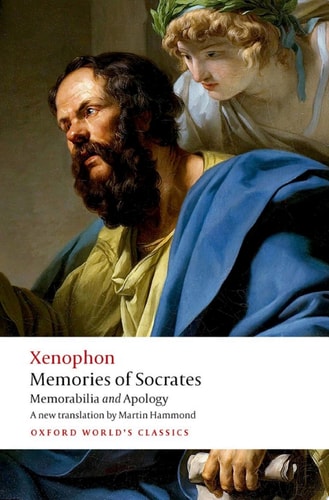
Memories of Socrates: Memorabilia and Apology
0
0
As an Amazon Associate and affiliate partner, Menrva Books earns from qualifying purchases. Learn more
Author Description
'Who would you say knows himself?' In 399 BCE Socrates was tried in Athens on charges of irreligion and corruption of the young, convicted, and sentenced to death. Like Plato, an almost exact contemporary, in his youth Xenophon (c. 430-c. 354 BCE) was one of the circle of mainly upper-class young Athenians attracted to Socrates' teaching. His Memorabilia is both a passionate defence of Socrates against those charges, and a kaleidoscopic picture of the man he knew, painted in a series of mini-dialogues and shorter vignettes, with a varied and deftly characterized cast—entitled and ambitious young men, atheists and hedonists, artists and artisans, Socrates' own stroppy teenage son Lamprocles, the glamorous courtesan Theodote. Topics given Socrates' characteristic questioning treatment include education, law, justice, government, political and military leadership, democracy and tyranny, friendship, care of the body and the soul, and concepts of the divine. Xenophon sees Socrates as above all a supreme moral educator, coaxing and challenging his associates to make themselves better people, not least by the example of how he lived his own life. Self-knowledge, leading to a reasoned self-control, was for Socrates the essential first step on the path to virtue, and some found it uncomfortable. The Apology is a moving account of Socrates' behaviour and bearing in his last days, immediately before, during, and after his trial.
Menrva's Summary
THE THESIS
How did Socrates navigate the moral and political pressures of Athenian society, and what does his conduct reveal about his philosophy of virtue? Xenophon, a student of Socrates and a prominent Athenian historian and soldier, utilizes his personal observations and historical accounts to construct a defense of his mentor. He argues that Socrates was a moral educator whose primary objective was to foster self-knowledge and self-control in his associates, rather than the corrupting influence his accusers claimed.
THE SCOPE MAP
What You Will Find
- A collection of dialogues and vignettes detailing Socratic interactions with various social classes.
- Philosophical inquiries into justice, leadership, friendship, and the nature of the divine.
- A historical account of the trial and final days of Socrates.
Scope Limits
- The text does not provide a comprehensive biography of Socrates' entire life.
- It does not offer an objective, neutral critique, as the author is explicitly writing from a position of defense and admiration.
THE AUTHORITY PERSPECTIVE
Scholars frequently utilize these texts as a vital counterpoint to the Platonic portrayal of Socrates, noting that Xenophon provides a more pragmatic and grounded perspective on the philosopher's daily life. Readers often observe that the prose is accessible yet dense with ethical arguments, making it a foundational resource for understanding the historical reception of Socratic thought.
Page Count:
304
Publication Date:
2023-01-01
Publisher:
OUP Oxford
ISBN-10:
0192598279
ISBN-13:
9780192598271
Biography
Philosophy
History
English & College Success
English
Community Tags
Similar Books