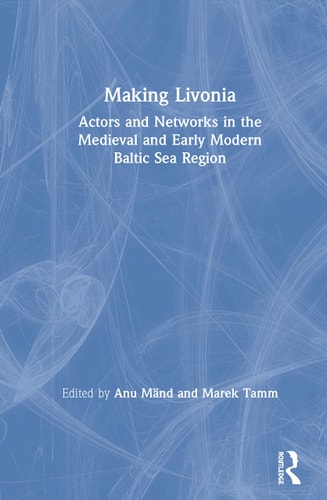
Making Livonia: Actors and Networks in the Medieval and Early Modern Baltic Sea Region
0
0
As an Amazon Associate and affiliate partner, Menrva Books earns from qualifying purchases. Learn more
Author Description
The region called Livonia (corresponding to modern Estonia and Latvia) emerged out of the rapid transformation caused by the conquest, Christianisation and colonisation on the north-east shore of the Baltic Sea in the late twelfth and the early thirteenth century. These radical changes have received increasing scholarly notice over the last few decades. However, less attention has been devoted to the interplay between the new and the old structures and actors in a longer perspective. This volume aims to study these interplays and explores the history of Livonia by concentrating on various actors and networks from the late twelfth to the seventeenth century. But on a deeper level the goal is more ambitious: to investigate the foundation of an increasingly complex and heterogeneous society on the medieval and early modern Baltic frontier - 'the making of Livonia'.
Menrva's Summary
THE THESIS
This volume investigates the complex formation of Livonia, a region in the Baltic Sea, by examining the interactions between various actors and networks from the late twelfth to the seventeenth century. The book focuses on the period of radical transformation following conquest, Christianization, and colonization in the late twelfth and early thirteenth centuries. It aims to explore the interplay between new and old structures and actors over a longer historical perspective, ultimately seeking to understand the foundation of an increasingly complex and heterogeneous society on the Baltic frontier.
THE SCOPE MAP
- An examination of the actors and networks that shaped Livonia from the late 12th to the 17th century.
- Analysis of the region's transformation through conquest, Christianization, and colonization.
- Exploration of the interplay between new and old societal structures.
- A focus on the Baltic Sea region as a frontier of complex societal development.
THE AUTHORITY PERSPECTIVE
The book is presented as a scholarly exploration of a specific historical region and period, focusing on social and network dynamics. The approach suggests an academic audience interested in detailed historical analysis of the Baltic Sea area during the medieval and early modern periods. The emphasis on 'actors and networks' indicates a methodology likely drawing from social history and potentially historical sociology, aiming to provide a nuanced understanding of societal formation.
Page Count:
344
Publication Date:
2020-01-01
Publisher:
Routledge, Taylor & Francis Group
ISBN-10:
0367273098
ISBN-13:
9780367273095
History
Non-Fiction
Social History
Baltic History
Cultural History
Community Tags
Other Editions(2)

Similar Books