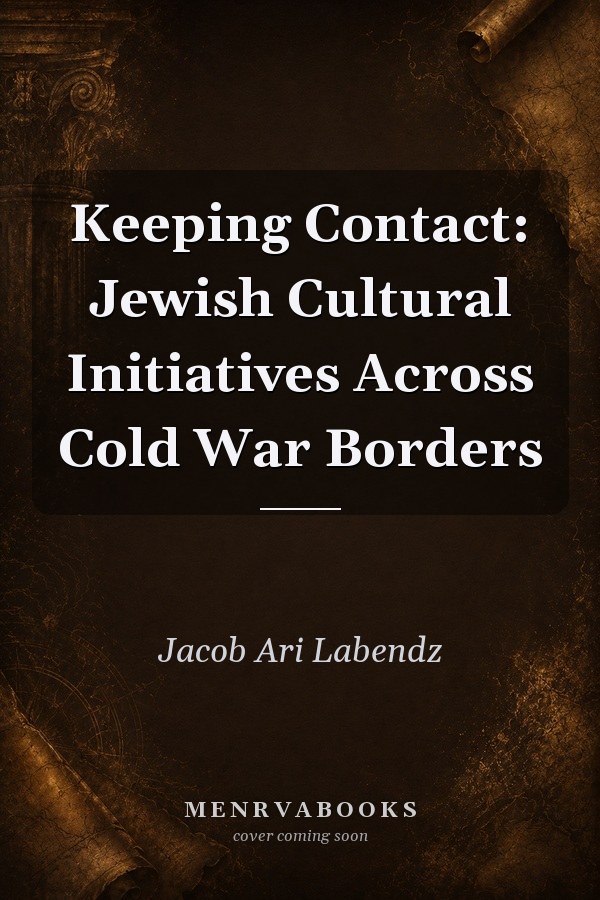
Keeping Contact: Jewish Cultural Initiatives Across Cold War Borders
0
0
As an Amazon Associate and affiliate partner, Menrva Books earns from qualifying purchases. Learn more
Author Description
Keeping Contact: Jewish Cultural Initiatives Across Cold War Borders builds upon discussions of Jewish survival and cultural viability after the Holocaust in Eastern and Central Europe, including the Soviet Union. This book confronts both a shifting postwar geopolitical landscape and the remnants of devastated European Jewish populations with their global diasporas, tragically and radically transformed. The volume traces the flow of ideas, people, cultural practices and materials, and even bodily remains across securitized Cold War borders, as the postwar geography of European Jewish life largely shifted to Israel and North America. How did Jews and Jewish institutions across hostile Cold War geopolitical boundaries seek and maintain contact with each other? Contact meant continuity. Contact was a means of mapping the Cold War terrain, of exploring strategies of adaptation, conservation, and reconstruction. It meant rabbis' reprised visits to the USSR, wholesale movement of libraries, dissent, dashed dreams of belonging, and urns of ashes.
Menrva's Summary
THE THESIS
This book investigates how Jewish communities and institutions maintained connections across the heavily securitized borders of the Cold War era. It examines the strategies employed by Jews in Eastern and Central Europe, including the Soviet Union, to preserve their cultural identity and ensure continuity in the face of a radically transformed geopolitical landscape and the aftermath of the Holocaust. The volume explores the movement of ideas, people, cultural practices, and even physical remains, as the center of Jewish life shifted towards Israel and North America.
THE SCOPE MAP
- Analysis of Jewish cultural initiatives and survival strategies in post-Holocaust Eastern and Central Europe.
- Examination of the flow of ideas, people, cultural practices, and materials across Cold War borders.
- Case studies of rabbis' visits to the USSR and the movement of libraries.
- Exploration of the impact of the geopolitical landscape on European Jewish life and its diasporas.
- Discussion of strategies for adaptation, conservation, and reconstruction of Jewish communities.
- Consideration of the movement of bodily remains, including urns of ashes.
THE AUTHORITY PERSPECTIVE
The book addresses the critical question of how Jewish communities maintained contact and continuity across hostile Cold War borders, a theme that resonates with the broader post-Holocaust discourse on Jewish survival and cultural viability. The scope of the work, tracing the movement of people, ideas, and cultural artifacts, suggests a comprehensive approach to understanding the resilience of Jewish identity in a fractured world. The inclusion of diverse elements, from rabbinical visits to the transfer of libraries and even ashes, points to a detailed and multifaceted exploration of the era's challenges and adaptations. The premise sets up an examination of how contact served as a vital mechanism for mapping the Cold War terrain and fostering strategies for cultural preservation.
Page Count:
350
Publication Date:
2026-07-15
Publisher:
Purdue University Press
ISBN-10:
1626712654
ISBN-13:
9781626712652
History
Non-Fiction
Cultural History
Jewish Studies
Community Tags
Similar Books