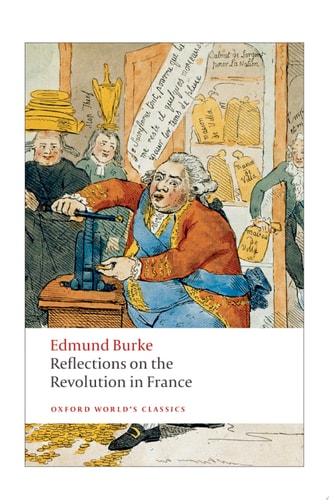
Reflections on the Revolution in France
0
0
As an Amazon Associate and affiliate partner, Menrva Books earns from qualifying purchases. Learn more
Author Description
Edmund Burke was the dominant political thinker of the last quarter of the eighteenth century in England. His reputation depends less on his role as a practising politician than on his ability to set contemporary problems within a wider context of political theory. Above all, he commented on change. He tried to teach lessons about how change should be managed, what limits should not be transgressed, and what should be reverently preserved. Burke's generation was much in need of advice on these matters. The Industrial Revolution, the American Revolution, and catastrophically, the French Revolution presented challenges of terrible proportions. They could promise paradise or threaten anarchy. Burke was acutely aware of how high the stakes were. The Reflections on the Revolution in France was a dire warning of the consequences that would follow the mismanagement of change. ABOUT THE SERIES: For over 100 years Oxford World's Classics has made available the widest range of literature from around the globe. Each affordable volume reflects Oxford's commitment to scholarship, providing the most accurate text plus a wealth of other valuable features, including expert introductions by leading authorities, helpful notes to clarify the text, up-to-date bibliographies for further study, and much more.
Menrva's Summary
THE THESIS
What are the long-term political and social consequences of radical, unmanaged revolutionary change? Edmund Burke, a prominent 18th-century statesman and political theorist, examines the French Revolution as a case study in the dangers of dismantling established institutions. He argues that society functions as a complex, organic structure that requires gradual reform rather than abrupt, violent upheaval. By contrasting the stability of British constitutional traditions with the volatility of French revolutionary fervor, Burke presents a foundational argument for the preservation of order and historical continuity.
THE SCOPE MAP
What You Will Find
- Analysis of the French Revolution's impact on European political stability
- Critique of abstract political theories and Enlightenment rationalism
- Defense of traditional institutions, including the monarchy and the church
- Examination of the relationship between individual liberty and social order
Scope Limits
- Does not provide a neutral historical account of the revolution's events
- Focuses primarily on the British perspective of continental European politics
THE AUTHORITY PERSPECTIVE
Scholars and political scientists recognize this work as a seminal text in the development of modern conservative thought. Readers frequently note the dense, rhetorical style of the prose, which reflects the oratorical traditions of the late 18th century.
Page Count:
500
Publication Date:
2009-01-01
Publisher:
OUP Oxford
ISBN-10:
019266946X
ISBN-13:
9780192669469
History
English & College Success
English
Conservative Thought
Public opinion
Political Philosophy
18th century
Community Tags
Other Editions(3)

Similar Books