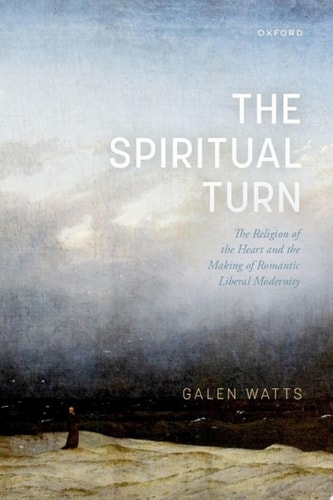
The Spiritual Turn: The Religion of the Heart and the Making of Romantic Liberal Modernity
0
0
As an Amazon Associate and affiliate partner, Menrva Books earns from qualifying purchases. Learn more
Author Description
Increasingly, North Americans and Western Europeans identify as 'spiritual but not religious'. But what does 'spirituality' actually mean? And what does this recent 'spiritual turn' reveal about the nature of twenty-first century liberal democracies? Secularization theorists argue that spirituality lacks institutional support and a shared tradition, thereby evincing religious decline. Meanwhile, critical commentators contend that the spiritual turn embodies all of the ills of post-1960s liberal democracies. This book challenges these popular misconceptions. Combining cultural sociology with intellectual history and political philosophy, and drawing from first-hand interview and fieldwork data, along with discourse analysis of best-selling books, it shows that rather than reflecting religious decline, the spiritual turn marks the rise of an enduring cultural structure in Western modernity-the religion of the heart. Tracing the religion of the heart to the 1960s, The Spiritual Turn illuminates its elective affinities with the romantic liberal social imaginary that crystallized in popular consciousness during this era, and transformed the institutional spheres of Western liberal democracies, eventually giving birth to a new social order-romantic liberal modernity. Then, inspired by the Durkheimian tradition, it presents case studies of three sites where the religion of the heart is institutionalized in a specific discursive form-a Twelve Step group, a neo-Pentecostal church, and a Toastmasters public speaking club. The book concludes that while critics may have reason to disparage both spirituality and romantic liberal modernity more generally, the reality is far more complex than their criticisms suggest-and more importantly, far less hopeless.
Menrva's Summary
THE THESIS
This book investigates the meaning of the contemporary 'spiritual but not religious' identity and its implications for the structure of twenty-first-century liberal democracies. Galen Watts, a scholar of cultural sociology and political philosophy, challenges the notion that the rise of spirituality signifies religious decline. Instead, he argues that the 'spiritual turn' represents the emergence of a 'religion of the heart,' a cultural structure deeply intertwined with the romantic liberal social imaginary that has shaped modern Western institutions.
THE SCOPE MAP
What You Will Find
- An analysis of the 'religion of the heart' as a cultural structure within Western modernity.
- A historical examination of the romantic liberal social imaginary originating in the 1960s.
- Case studies of institutionalized spirituality in a Twelve Step group, a neo-Pentecostal church, and a Toastmasters club.
Scope Limits
- The study focuses primarily on North American and Western European contexts.
- It does not provide a comprehensive history of all global spiritual movements.
THE AUTHORITY PERSPECTIVE
Experts recognize this work as a sophisticated synthesis of sociology, history, and political theory that moves beyond binary debates about secularization. Readers frequently note the academic density of the prose, which provides a rigorous framework for understanding the intersection of personal spirituality and political modernity.
Page Count:
272
Publication Date:
2022-01-01
Publisher:
OUP Oxford
ISBN-10:
0192676032
ISBN-13:
9780192676030
Religion
History
Political Philosophy
Cultural History
Secularization
Modernity
Sociology
Community Tags
Similar Books