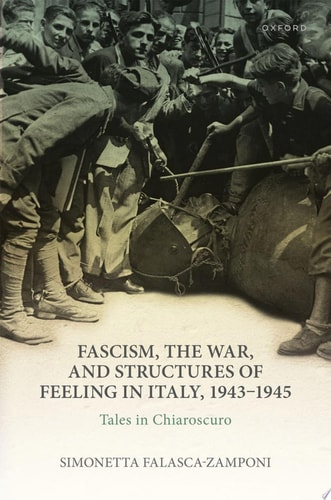
Fascism, the War, and Structures of Feeling in Italy, 1943-1945: Tales in Chiaroscuro
0
0
As an Amazon Associate and affiliate partner, Menrva Books earns from qualifying purchases. Learn more
Author Description
On July 25, 1943, news of Mussolini's resignation and subsequent arrest stunned Italians leaving them dumbfounded. After two decades, fascism had fallen without any advance warning. As festive events marked the incredible outcome and reminders of the past were destroyed, an uncontainable joy seemed to pervade Italians. But what did people actually celebrate? How did they understand the bygone dictatorship, which was soon to be reincarnated in the Italian Social Republic (RSI)? Drawing on more than one hundred diaries written by ordinary citizens (and some prominent figures as well) and inspired by Raymond Williams's concept of structures of feeling, the book examines Italians' perspectives on fascism at a very critical moment in their history. With the country mired in a devastating war further complicated by the September 8, 1943 armistice with the Allies and subsequent German occupation--followed by the eruption of an Italian-against-Italian conflict, the switching of alliances, and the declaration of war against Germany on October 13, 1943--the fast pace of history seemed to deflect Italians' attention from their immediate past.Amidst the daily experience of bombings, hunger, displacement, and death, coming to terms with twenty years of dictatorship turned out to be an arduous enterprise. Whether those who had lived under the fascist regime wished 'not to think of it and not to speak any more about it' as philosopher Benedetto Croce maintained, it is hard to ascertain. In truth, little is known of what Italians felt and thought about fascism after its precipitous demise. This book remedies the gap in historical scholarship by assessing how Italians confronted their present and negotiated their past during the two years from the fall of the regime to the definitive defeat of the RSI and the end of the world war in May 1945. By bringing to life the cultural imaginaries and practices of the past, the book raises ostensibly intractable questions on the epochal impact
Menrva's Summary
THE THESIS
This book investigates how ordinary Italians perceived and processed the collapse of the fascist regime and the subsequent chaos of the final years of World War II. Prof. Simonetta Falasca-Zamponi utilizes the theoretical framework of Raymond Williams's 'structures of feeling' to analyze the subjective experiences of citizens during this volatile period. By synthesizing over one hundred personal diaries, the author reconstructs the psychological and cultural landscape of a society transitioning from dictatorship to civil war and occupation.
THE SCOPE MAP
What You Will Find
- Analysis of Italian civilian perspectives between 1943 and 1945
- Application of cultural theory to historical diary entries
- Examination of the transition from the fall of Mussolini to the end of the Italian Social Republic
- Documentation of daily life under the pressures of occupation, hunger, and shifting alliances
Scope Limits
- The study focuses primarily on the subjective 'structures of feeling' rather than a comprehensive military or diplomatic history of the conflict.
THE AUTHORITY PERSPECTIVE
Scholars recognize this work as a significant contribution to the cultural history of Italy, particularly for its innovative use of personal narratives to fill gaps in traditional political historiography. Readers often note the academic rigor of the text, which provides a nuanced look at the internal contradictions of the Italian populace during the final years of the war.
Page Count:
352
Publication Date:
2023-09-22
Publisher:
Oxford University Press
ISBN-10:
0192887505
ISBN-13:
9780192887504
History
Italian History
World War
Cultural History
European History
Community Tags
Similar Books