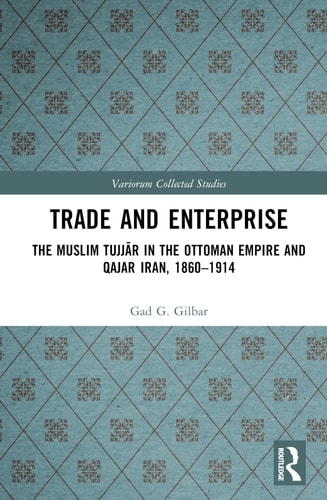
Trade and Enterprise: The Muslim Tujjar in the Ottoman Empire and Qajar Iran, 1860-1914
0
0
As an Amazon Associate and affiliate partner, Menrva Books earns from qualifying purchases. Learn more
Author Description
Until recently, the historiography of Middle Eastern economic elites during the first globalization has ignored the significant role played by Muslim tujjār (big merchant-entrepreneurs). Foreign firms and local minorities were considered the prime agents of economic change and the initiators of economic growth. The 12 studies in this volume show that the Muslim tujjār played a major economic role in various regions of the Middle East during the late nineteenth and early twentieth centuries. Their investments, mainly in commercial agriculture, resulted in economic growth and changed economic structures and social relations in many Middle Eastern communities. They were also involved in political developments, some of which had a dramatic effect on the history of their countries, as for instance in late Qajar Iran. They also played a unique role in the process of cultural change. Although they supported the ʿulamāʾ financially, they also contributed to the establishment of new educational and cultural institutions. The story of the tujjār is unique in the sense that it was the only indigenous elite group in the pre-World War I Middle East to bridge between traditional forces and concepts and Western attitudes and practices. (CS 1108).
Menrva's Summary
THE THESIS
This volume challenges the traditional view of Middle Eastern economic elites by highlighting the significant, yet often overlooked, role of Muslim tujjār (big merchant-entrepreneurs) during the first wave of globalization. The studies presented demonstrate that these Muslim merchants were not merely passive recipients of foreign influence but active agents of economic change, primarily through investments in commercial agriculture, which reshaped economic structures and social relations across various regions of the Middle East from 1860 to 1914. Their influence extended into the political and cultural spheres, bridging traditional and Western concepts, and contributing to both the support of the 'ulama' and the establishment of new institutions.
THE SCOPE MAP
- Analysis of the role of Muslim tujjār in the Ottoman Empire and Qajar Iran between 1860 and 1914.
- Examination of how Muslim merchant-entrepreneurs challenged the historiographical focus on foreign firms and local minorities as the sole drivers of economic change.
- Detailed case studies of tujjār investments, particularly in commercial agriculture, and their impact on economic growth and structural transformation.
- Exploration of the social and cultural changes instigated or influenced by the tujjār within Middle Eastern communities.
- Investigation of the political involvement of tujjār and their influence on national developments, with specific attention to late Qajar Iran.
- Discussion of the unique position of the tujjār as an indigenous elite group that navigated between traditional and Western influences.
- Insights into the financial support provided by tujjār to the 'ulama' alongside their contributions to new educational and cultural institutions.
THE AUTHORITY PERSPECTIVE
This collection of studies aims to re-center the narrative of Middle Eastern economic history by foregrounding the agency of Muslim tujjār. The work posits that these merchants were pivotal in driving economic growth and societal transformation during a critical period of global integration. By examining their multifaceted roles in commerce, politics, and culture, the volume seeks to provide a more nuanced understanding of elite influence and indigenous modernization.
Page Count:
284
Publication Date:
2023-01-01
Publisher:
Routledge, Taylor & Francis Group
ISBN-10:
1032011599
ISBN-13:
9781032011592
History
Non-Fiction
Social History
Economic History
Business History
Community Tags
Other Editions(3)
Similar Books