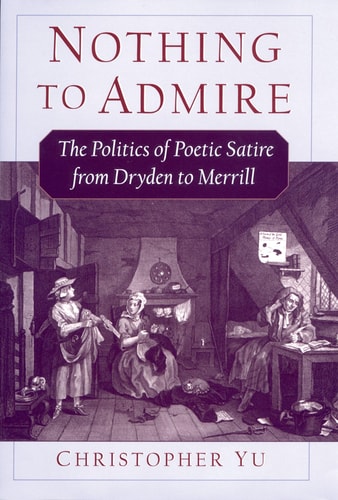
Nothing to Admire: The Politics of Poetic Satire from Dryden to Merrill
0
0
As an Amazon Associate and affiliate partner, Menrva Books earns from qualifying purchases. Learn more
Author Description
Nothing to Admire argues for the persistence of a central tradition of poetic satire in English that extends from Restoration England to present-day America. This tradition is rooted in John Dryden's and Alexander Pope's uses of Augustan metaphor to criticize the abuse of social and political power and to promote an antithetical ideal of satiric authority based on freedom of mind. Because of their commitment to neoclassical conceptions of political virtue, the British Augustans developed a meritocratic cultural ideal grounded in poetic judgment and opposed to the political institutions and practices of their superiors in birth, wealth, and might. Their Augustanism thus gives a political meaning to the Horatian principle of nil admirari. This book calls the resulting outlook cultural liberalism in order to distinguish it from the classical liberal insistence on private property as the basis of political liberty, a conviction that arises within the same general period and often stands in adversarial relation to the Augustan mentality.Dryden and Pope's language of political satire supplies the foundation for the later and more radical liberalisms of Lord Byron, W.H. Auden, and James Merrill, each of whom looks back to the Augustan model for the poetic devices he will use to protest the increasingly conformist culture of mass society. Responding to the banality of this society, the later poets reinvigorate their predecessors' neo-Horatian attitude of skeptical worldliness through iconoclastic comic assaults on the imperial, fascist, heterosexist, and otherwise illiberal impulses of the cultural regimes prevailing during their lifetimes.
Menrva's Summary
THE THESIS
This work investigates the historical continuity and political function of poetic satire in English literature, tracing its evolution from the Augustan era to the modern period. Christopher Yu, a scholar of English literature, examines how poets from John Dryden to James Merrill utilize neoclassical metaphors to challenge institutional power. By analyzing the concept of cultural liberalism, the author argues that these poets employ a specific, skeptical mode of satire to defend intellectual freedom against the pressures of mass society and conformist political regimes.
THE SCOPE MAP
What You Will Find
- A historical analysis of the Horatian principle of nil admirari as a political tool.
- Comparative studies of John Dryden, Alexander Pope, Lord Byron, W.H. Auden, and James Merrill.
- A theoretical framework distinguishing cultural liberalism from classical liberal property-based ideologies.
- Examination of poetic devices used to critique imperial, fascist, and heterosexist cultural structures.
THE AUTHORITY PERSPECTIVE
Scholars recognize this text as a rigorous exploration of the intersection between formal poetic technique and political philosophy. Readers frequently note the academic density of the prose, which provides a sophisticated synthesis of literary history and political theory.
Page Count:
232
Publication Date:
2003-09-11
Publisher:
Oxford University Press
ISBN-10:
0195155300
ISBN-13:
9780195155303
Poetry
History
English & College Success
American poetry
Criticism history
Literary Criticism
English
English poetry
Community Tags
Similar Books