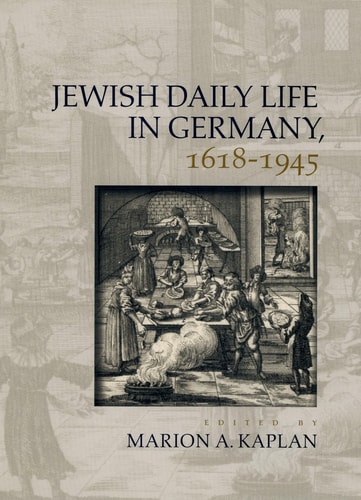
Jewish Daily Life in Germany, 1618-1945
0
0
As an Amazon Associate and affiliate partner, Menrva Books earns from qualifying purchases. Learn more
Author Description
From the seventeenth century until the Holocaust, Germany's Jews lurched between progress and setback, between fortune and terrible misfortune. German society shunned Jews in the eighteenth century and opened unevenly to them in the nineteenth and early twentieth centuries, only to turn murderous in the Nazi era. By examining the everyday lives of ordinary Jews, this book portrays the drama of German-Jewish history -- the gradual ascent of Jews from impoverished outcasts to comfortable bourgeois citizens and then their dramatic descent into genocidal torment during the Nazi years. Building on social, economic, religious, and political history, it focuses on the qualitative aspects of ordinary life -- emotions, subjective impressions, and quotidian perceptions. How did ordinary Jews and their families make sense of their world? How did they construe changes brought about by industrialization? How did they make decisions to enter new professions or stick with the old, juggle traditional mores with contemporary ways? The Jewish adoption of secular, modern European culture and the struggle for legal equality exacted profound costs, both material and psychological. Even in the heady years of progress, a basic insecurity informed German-Jewish life. Jewish successes existed alongside an antisemitism that persisted as a frightful leitmotif throughout German-Jewish history. And yet the history that emerges from these pages belies simplistic interpretations that German antisemitism followed a straight path from Luther to Hitler. Neither Germans nor Jews can be typecast in their roles vis à vis one another. Non-Jews were not uniformly antisemitic but exhibited a wide range of attitudes towards Jews. Jewish daily life thus provides another vantage point from which to study the social life of Germany. Focusing on both internal Jewish life -- family, religion, culture and Jewish community -- and the external world of German culture and society provides a uniquely well-rounded po
Menrva's Summary
THE THESIS
This work investigates the complex evolution of Jewish daily life in Germany from the seventeenth century through the Holocaust to determine how ordinary individuals navigated the shifting landscape of social, economic, and political integration. Marion A. Kaplan, a scholar of German-Jewish history, utilizes a social history framework to move beyond macro-political narratives. By analyzing personal accounts, economic shifts, and cultural adaptations, she argues that the German-Jewish experience was defined by a persistent tension between successful bourgeois integration and the ever-present threat of antisemitism.
THE SCOPE MAP
What You Will Find
- A longitudinal analysis of German-Jewish social and economic history from 1618 to 1945.
- Examination of the qualitative aspects of daily life, including family dynamics, religious practice, and professional choices.
- Integration of primary source material reflecting subjective impressions and emotional responses to modernization.
- A nuanced exploration of the relationship between Jewish communities and the broader German society, challenging monolithic interpretations of antisemitism.
THE AUTHORITY PERSPECTIVE
Historians and scholars of Jewish studies frequently cite this text for its ability to humanize large-scale historical shifts through the lens of individual experience. Experts highlight the book as a significant contribution to the field for its refusal to treat the history of German antisemitism as a predetermined, linear progression.
Page Count:
244
Publication Date:
2005-03-03
Publisher:
Oxford University Press
ISBN-10:
0195171640
ISBN-13:
9780195171648
History
Social History
Jews
Germany history
European History
Cultural History
Social Life
Jewish Studies
Jews germany
Community Tags
Other Editions(3)

Similar Books










Reader Comments
Share Your Thoughts
No comments yet. Be the first to share your thoughts!