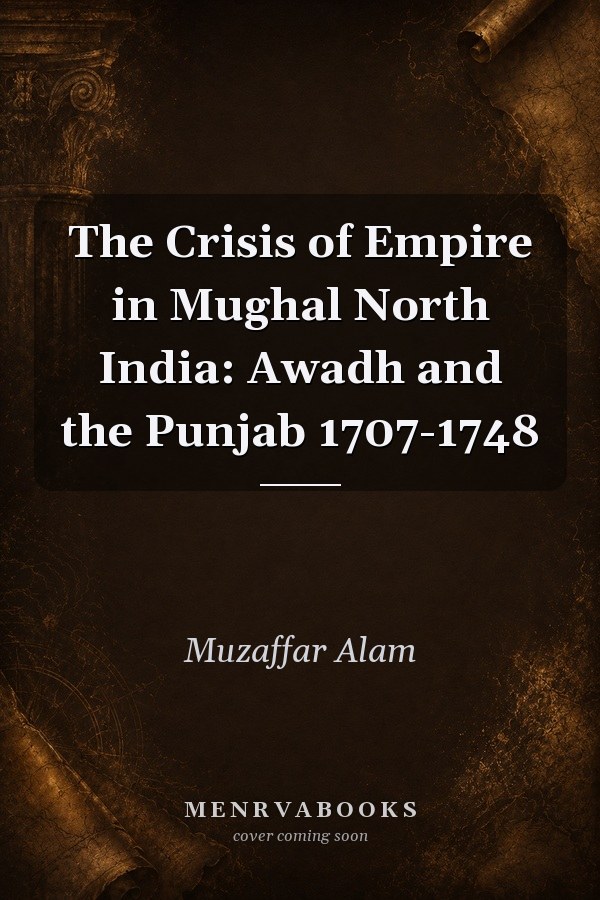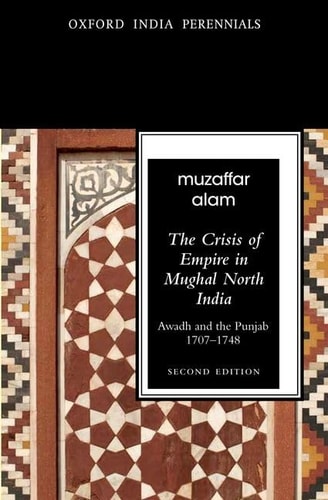
The Crisis of Empire in Mughal North India: Awadh and Punjab, 1707-48
0
0
As an Amazon Associate and affiliate partner, Menrva Books earns from qualifying purchases. Learn more
Author Description
The period following the death of Aurangzeb has been viewed as the beginning of the decline and decay of the Mughal empire. Examining two contrasting regions of north India-Awadh and Punjab-this pioneering work shows how the period 1707-48 saw the emergence of a new order with local and regional idioms. Muzaffar Alam focuses on the interplay of imperial collapse with regional restructuring. He contends that even as the empire declined, there emerged a new, regionally-based political order, maintained and controlled by former Mughal rulers. From agrarian uprisings to the jagirdari system, the Sikhs to the Zamindars, this book presents a bold new interpretation of an important transition in this period. This edition comes with a new introduction.This book is an important reading for students, scholars, and teachers of Mughal history and early modern India.
Menrva's Summary
THE THESIS
This work investigates whether the post-Aurangzeb era in Mughal India represents a period of total imperial decay or a complex transition toward new, regionally-based political structures. Muzaffar Alam, a distinguished historian of early modern India, utilizes extensive archival research and administrative records to challenge the traditional historiography of decline. He argues that the collapse of central authority facilitated the rise of regional power centers in Awadh and Punjab, which maintained continuity through adapted Mughal administrative practices.
THE SCOPE MAP
What You Will Find
- Comparative analysis of political and agrarian restructuring in Awadh and Punjab between 1707 and 1748.
- Examination of the jagirdari system and its role in regional economic shifts.
- Evaluation of the impact of local uprisings, including the role of the Sikhs and various Zamindar classes.
- A scholarly framework for understanding the transition from imperial hegemony to regional autonomy.
THE AUTHORITY PERSPECTIVE
Experts recognize this text as a foundational study that shifted the academic discourse on the decline of the Mughal Empire. Scholars frequently cite the book for its rigorous regional analysis and its nuanced challenge to the narrative of total systemic collapse.
Page Count:
400
Publication Date:
2013-05-10
Publisher:
Oxford University Press
ISBN-10:
0198077416
ISBN-13:
9780198077411
History
Mogul Empire
Asian History
History India
India
Punjab India
Political History
Mughal Empire
Community Tags
Similar Books