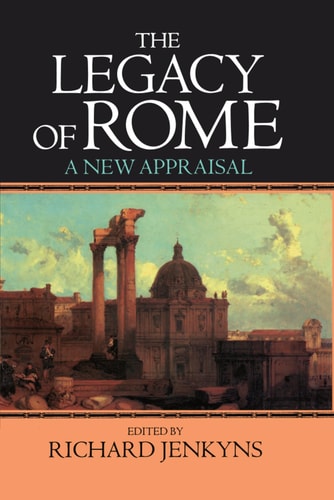
The Legacy of Rome: A New Appraisal
0
0
As an Amazon Associate and affiliate partner, Menrva Books earns from qualifying purchases. Learn more
Author Description
If the grandeur that was Rome has long since vanished, the impact of the Eternal City can still be felt in virtually every corner of Western culture. Students of speech and rhetoric to this day study the works of Cicero for guidance. We find Roman Law setting the model for legal systems from the twelfth century to the present. And Latin itself, far from being a "dead language," lives on not only in the Romance languages, but also in English vocabulary and grammar. Rhetoric, language, law--these are just a small part of the great Roman influence that has lasted throughout the centuries.The Legacy of Rome has long been considered the standard introduction to the achievements of the Roman world. Now in a completely new edition, this classic work brings together the latest scholarship in the field from some of the world's leading classical scholars. Unlike the previous version, which focused on such narrow topics as commerce and administration, the new edition broadens the spectrum of influence, showing the impact, for example, of Roman literature, art, politics, law, and language on western civilization. Jasper Griffin, for instance, looks to the works of Shakespeare, Milton, Keats, and Wordsworth, among others, to trace the lasting influence of the great Roman poet Virgil on the development of poetic forms such as the pastoral, epitomized by Virgil's Eclogues, and the epic poem, exemplified by the Aeneid. A.T. Grafton shows how Renaissance intellectuals such as Machiavelli and Guicciardini looked to Rome's past for political enlightenment, and found models of military strategy in the works of Tacitus and Livy. Editor Richard Jenkyns dispels the misconception of the Romans as purely imitative of the Greeks; he points out such uniquely Roman concepts as jurisprudence and citizenship, and architecture based on the round arch and the vault, as evidence of Roman innovativeness. Other contributors--George A. Kennedy, Robert Feenstra, and Nicholas Purcell--discuss the import
Menrva's Summary
THE THESIS
This work investigates the enduring influence of Roman civilization on the development of Western culture, law, language, and political thought. Edited by Richard Jenkyns, the book compiles essays from leading classical scholars to re-evaluate the Roman contribution to modern society. By moving beyond traditional focuses on commerce and administration, the contributors argue that Roman innovation in jurisprudence, architecture, and literature provided the foundational framework for subsequent European intellectual history.
THE SCOPE MAP
What You Will Find
- Analysis of Roman influence on Western literature, including the works of Shakespeare, Milton, and Keats.
- Examination of Roman legal systems and their role as models for modern jurisprudence.
- Discussion of architectural advancements, specifically the development of the round arch and the vault.
- Historical assessment of Roman political concepts, including citizenship and military strategy as interpreted by Renaissance thinkers.
THE AUTHORITY PERSPECTIVE
Experts recognize this collection as a comprehensive and updated resource for understanding the multifaceted legacy of the Roman world. Readers frequently note the academic rigor of the essays, which successfully bridge the gap between specialized classical scholarship and broader historical inquiry.
Page Count:
518
Publication Date:
1992-04-16
Publisher:
Oxford University Press
ISBN-10:
0198219172
ISBN-13:
9780198219170
History
Roman History
Cultural History
Western Civilization
Rome
Community Tags
Other Editions(2)

Similar Books



Reader Comments
Share Your Thoughts
No comments yet. Be the first to share your thoughts!