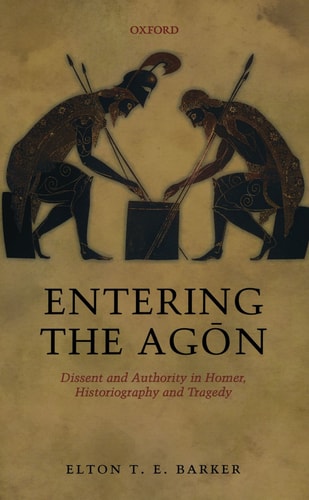
Entering the Agon: Dissent and Authority in Homer, Historiography, and Tragedy
0
0
As an Amazon Associate and affiliate partner, Menrva Books earns from qualifying purchases. Learn more
Author Description
This book investigates one of the most characteristic and prominent features of ancient Greek literature - the scene of debate or agon, in which with varying degrees of formality characters square up to each other and engage in a contest of words. Drawing on six case studies of different kinds of narrative - epic, historiography and tragedy - and authors as diverse as Homer, Herodotus, Thucydides, Sophocles and Euripides, this wide-ranging study analyses each example of debate in its context according to a set of interrelated questions: who debates, when, why, and with what consequences? Based on the changing representations of debate across and within different genres, it shows the importance of debate to these key canonical genres and, in turn, the role of literature in the construction of a citizen body through the exploration, reproduction and management of dissent from authority.
Menrva's Summary
THE THESIS
This book investigates the function and significance of the agon, or formal scene of debate, as a mechanism for managing dissent and authority within ancient Greek literature. Elton T. E. Barker, a scholar of classical literature, utilizes a comparative framework to examine how verbal contests serve as a foundational element in the construction of civic identity. By analyzing the structural role of debate across epic, historiography, and tragedy, the author argues that these literary encounters are essential for understanding how Greek society navigated the tension between individual expression and institutional authority.
THE SCOPE MAP
What You Will Find
- Comparative analysis of debate scenes in Homer, Herodotus, Thucydides, Sophocles, and Euripides.
- A methodological framework for evaluating the participants, timing, and consequences of verbal contests.
- Examination of the intersection between literary narrative and the development of citizen identity.
- Case studies focusing on the management of dissent within canonical Greek genres.
THE AUTHORITY PERSPECTIVE
Scholars and students of classical literature identify this work as a rigorous examination of the rhetorical and political dimensions of Greek narrative. Readers frequently note the academic density of the prose, which provides a sophisticated analysis of how ancient texts codified the relationship between authority and public discourse.
Page Count:
448
Publication Date:
2011-07-07
Publisher:
Oxford University Press
ISBN-10:
0199609284
ISBN-13:
9780199609284
History
Philosophy
English
Literary Criticism
English & College Success
Criticism history
Greece
Greek drama
Community Tags
Similar Books