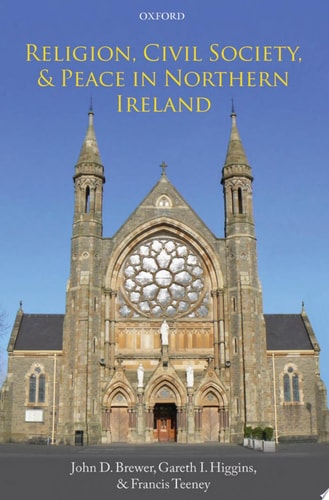
Religion, Civil Society, and Peace in Northern Ireland
0
0
As an Amazon Associate and affiliate partner, Menrva Books earns from qualifying purchases. Learn more
Author Description
Religion was thought to be part of the problem in Ireland and incapable of turning itself into part of the solution. Many commentators deny the churches a role in Northern Ireland's peace process or belittle it, focusing on the few well-known events of church involvement and the small number of high profile religious peacebuilders. This new study seeks to correct various misapprehensions about the role of the churches by pointing to their major achievements in both the social and political dimensions of the peace process, by small-scale, lesser-known religious peacebuilders as well as major players. The churches are not treated lightly or sentimentally and major weaknesses in their contribution are highlighted. The study challenges the view that ecumenism was the main religious driver of the peace process, focusing instead on the role of evangelicals, it warns against romanticising civil society, pointing to its regressive aspects and counter-productive activities, and queries the relevance of the idea of 'spiritual capital' to understanding the role of the churches in post-conflict reconstruction, which the churches largely ignore.This book is written by three 'insiders' to church peacebuilding in Northern Ireland, who bring their insight and expertise as sociologists to bear in their analysis of four-years in-depth interviewing with a wide cross section of people involved in the peace process, including church leaders and rank-and-file, members of political parties, prime ministers, paramilitary organisations, community development and civil society groups, as well as government politicians and advisors. Many of these are speaking for the first time about the role of religious peacebuilding in Northern Ireland, and doing so with remarkable candour. The volume allows the Northern Irish case study to speak to other conflicts where religion is thought to be problematic by developing a conceptual framework to understand religious peacebuilding.
Menrva's Summary
THE THESIS
This study investigates the complex, often overlooked role of religious institutions and actors in the Northern Ireland peace process, challenging the assumption that religion is solely a source of conflict. The authors, all sociologists with direct experience in the field, utilize four years of in-depth interviews to analyze how churches and religious individuals contributed to social and political reconciliation. By moving beyond high-profile events, the text provides a nuanced examination of both the achievements and the significant failures of religious peacebuilding efforts.
THE SCOPE MAP
What You Will Find
- Analysis of the role of evangelicals versus ecumenical movements in peacebuilding.
- Critical evaluation of the concept of 'spiritual capital' in post-conflict reconstruction.
- Primary source data derived from extensive interviews with church leaders, politicians, and paramilitary members.
- A conceptual framework for applying the Northern Irish case study to other global conflicts involving religious tension.
THE AUTHORITY PERSPECTIVE
Experts recognize this work as a rigorous sociological examination that avoids sentimentalizing religious involvement in political conflict. Readers frequently note the academic density of the prose and the value of the candid, first-hand accounts provided by participants in the peace process.
Page Count:
304
Publication Date:
2012-02-20
Publisher:
Oxford University Press
ISBN-10:
0199694028
ISBN-13:
9780199694020
History
Religion
Sociology
Politics & Government
Ireland
Peace studies
Conflict Resolution
Community Tags
Other Editions(2)
Similar Books


Reader Comments
Share Your Thoughts
No comments yet. Be the first to share your thoughts!