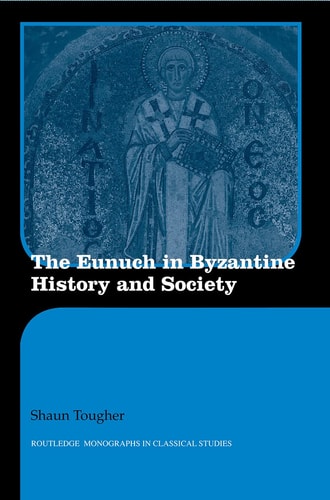
The Eunuch in Byzantine History and Society
0
0
As an Amazon Associate and affiliate partner, Menrva Books earns from qualifying purchases. Learn more
Author Description
The existence of eunuchs was one of the defining features of the Byzantine Empire. Covering the whole span of the history of the empire, from the fourth to the fifteenth centuries AD, Shaun Tougher presents a comprehensive survey of the history and roles of eunuchs, making use of extensive comparative material, such as from China, Persia and the Ottoman Empire, as well as about castrato singers of the eighteenth century of Enlightenment Europe, and self-castrating religious devotees such as the Galli of ancient Rome, early Christians, the Skoptsy of Russia and the Hijras of India.The various roles played by eunuchs are examined. They are not just found as servile attendants; some were powerful political players – such as Chrysaphius who plotted to assassinate Attila the Hun – and others were prominent figures in Orthodoxy as bishops and monks. Furthermore, there is offered an analysis of how society thought about eunuchs, especially their gender identity - were they perceived as men, women, or a third sex?The broad survey of the political and social position of eunuchs in the Byzantine Empire is placed in the context of the history of the eunuch in general. An appendix listing key eunuchs of the Byzantine Empire describing their careers is included, and the text is fully illustrated.
Menrva's Summary
THE THESIS
This work investigates the multifaceted role and social perception of eunuchs throughout the entire duration of the Byzantine Empire, from the fourth to the fifteenth centuries. Shaun Tougher, a scholar specializing in Byzantine history, utilizes a comparative framework to analyze how these individuals functioned within imperial administration, religious institutions, and the broader social hierarchy. By integrating cross-cultural data from China, Persia, and the Ottoman Empire, the author challenges traditional assumptions about the status and gender identity of eunuchs in the medieval world.
THE SCOPE MAP
What You Will Find
- A chronological survey of eunuch history spanning over a millennium of Byzantine rule.
- Comparative analysis involving diverse historical groups including the Galli of Rome, the Skoptsy of Russia, and the Hijras of India.
- Examination of specific political figures such as Chrysaphius and their influence on imperial policy.
- An analytical framework regarding gender identity and the classification of eunuchs as a distinct social category.
- A comprehensive appendix detailing the careers of key eunuchs within the empire.
THE AUTHORITY PERSPECTIVE
Scholars and historians recognize this text as a foundational resource for understanding the social structures of the Byzantine Empire. Readers frequently note the academic density of the prose and the breadth of the comparative research provided by the author.
Page Count:
0
Publication Date:
2008-01-01
Publisher:
Taylor & Francis, Inc.
ISBN-10:
0203866207
ISBN-13:
9780203866207
History
Cultural History
Gender Studies
Social History