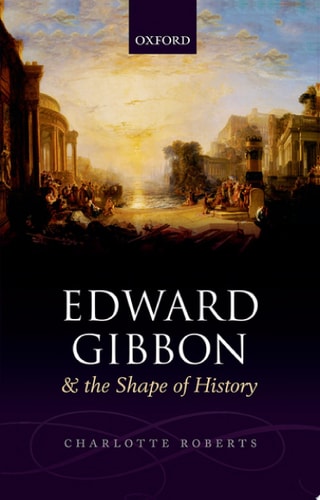
Edward Gibbon and the Shape of History
0
0
As an Amazon Associate and affiliate partner, Menrva Books earns from qualifying purchases. Learn more
Author Description
Edward Gibbon's presentation of character in both the History of the Decline and Fall of the Roman Empire and in his posthumously published Memoirs demonstrates a prevailing interest in the values of transcendent heroism and individual liberty, but also an insistent awareness of the dangers these values pose to coherence and narrative order. In this study, Charlotte Roberts demonstrates how these dynamics also inform the 'character' of the Decline and Fall: in which ironic difference confronts enervating uniformity; oddity counters specious lucidity; and revision combats repetition. Edward Gibbon and the Shape of History explores the Decline and Fall as a work of scholarship and of literature, tracing both its expansive outline and its expressive details. A close examination of each of the three instalments of Gibbon's history reveals an intimate relationship between the style of Gibbon's narrative and the overall shape of his historiographical composition. The constant interplay between style and substance, or between the particular details of composition and the larger patterns of argument and narrative, informs every aspect of Gibbon's work: from his reception of established and innovative historiographical conventions to the expression of his narrative voice. Through a combination of close reading and larger literary and scholarly analysis, Charlotte Roberts conveys a sense of the Decline and Fall as a work more complex and conflicted, in its tone and structure, than has been appreciated by previous scholars, without losing sight of the grand contours of Gibbon's superlative achievement.
Menrva's Summary
THE THESIS
This study investigates how Edward Gibbon’s presentation of character and narrative style fundamentally shapes the structure and argument of his seminal work, The History of the Decline and Fall of the Roman Empire. Charlotte Roberts, a scholar of eighteenth-century literature, utilizes a combination of close textual analysis and historical context to argue that Gibbon’s work is more complex and conflicted than traditional interpretations suggest. By examining the interplay between individual characterization and historiographical conventions, Roberts demonstrates how Gibbon balanced the tension between transcendent heroism and the requirements of narrative coherence.
THE SCOPE MAP
What You Will Find
- Analysis of the three distinct installments of The History of the Decline and Fall of the Roman Empire
- Examination of Gibbon’s posthumously published Memoirs
- Exploration of the relationship between narrative voice and historiographical composition
- Discussion of the tension between ironic difference and narrative uniformity
Scope Limits
- Does not provide a comprehensive biography of Gibbon’s entire life outside of his literary output
- Does not serve as a general history of the Roman Empire itself, but rather a study of Gibbon’s specific historiographical method
THE AUTHORITY PERSPECTIVE
Scholars recognize this work as a significant contribution to the study of eighteenth-century historiography and literary style. Readers frequently note the academic density of the prose, which provides a rigorous framework for understanding the structural complexities of Gibbon’s writing.
Page Count:
208
Publication Date:
2014-01-01
Publisher:
OUP Oxford
ISBN-10:
0191014907
ISBN-13:
9780191014901
History
Biography
Non-Fiction
Literary Criticism
Historiography
English & College Success
English
Community Tags
Other Editions(3)

Similar Books



Reader Comments
Share Your Thoughts
No comments yet. Be the first to share your thoughts!