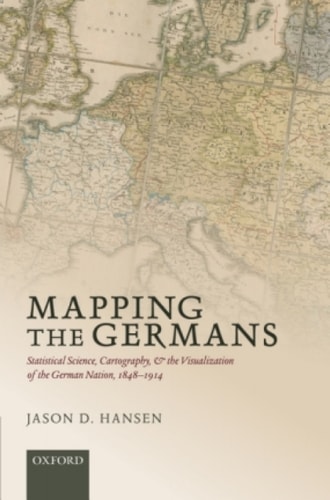
Mapping the Germans: Statistical Science, Cartography, and the Visualization of the German Nation, 1848-1914
0
0
As an Amazon Associate and affiliate partner, Menrva Books earns from qualifying purchases. Learn more
Author Description
Mapping the Germans explores the development of statistical science and cartography in Germany between the beginning of the nineteenth century and the start of World War One, examining their impact on the German national identity. It asks how spatially-specific knowledge about the nation was constructed, showing the contested and difficult nature of objectifying this frustratingly elastic concept. Ideology and politics were not themselves capable of providing satisfactory answers to questions about the geography and membership of the nation; rather, technology also played a key role in this process, helping to produce the scientific authority needed to make the resulting maps and statistics realistic. In this sense, Mapping the Germans is about how the abstract idea of the nation was transformed into a something that seemed objectively measurable and politically manageable. Jason Hansen also examines the birth of radical nationalism in central Europe, advancing the novel argument that it was changes to the vision of nationality rather than economic anxieties or ideological shifts that radicalized nationalist practice at the close of the nineteenth century. Numbers and maps enabled activists to "see" nationality in local and spatially-specific ways, enabling them to make strategic decisions about where to best direct their resources. In essence, they transformed nationality into something that was actionable, that ordinary people could take real actions to influence.
Menrva's Summary
THE THESIS
How did the intersection of statistical science and cartography facilitate the construction of German national identity between 1848 and 1914? Jason D. Hansen, a scholar of modern European history, investigates the technical and political processes that transformed the abstract concept of the nation into a measurable, manageable entity. By analyzing the development of spatial knowledge, Hansen argues that the ability to visualize nationality through maps and statistics provided the scientific authority necessary to radicalize nationalist practices at the end of the nineteenth century.
THE SCOPE MAP
What You Will Find
- Analysis of the evolution of statistical science and cartographic techniques in Germany.
- Examination of the relationship between technical data visualization and political ideology.
- Historical investigation into the rise of radical nationalism in Central Europe.
Scope Limits
- The study focuses specifically on the period between 1848 and 1914.
- The text does not provide a comprehensive history of German political parties or economic policy outside the context of spatial data.
THE AUTHORITY PERSPECTIVE
Scholars recognize this work as a significant contribution to the study of how scientific tools shaped modern political consciousness. Readers frequently note the academic density of the prose and the meticulous archival research that supports the author's arguments regarding the visualization of the nation.
Page Count:
232
Publication Date:
2015-01-01
Publisher:
OUP Oxford
ISBN-10:
0191023876
ISBN-13:
9780191023873
History
Cartography
German history
Statistics
Nationalism
European History
Community Tags
Other Editions(3)
Similar Books













Reader Comments
Share Your Thoughts
No comments yet. Be the first to share your thoughts!