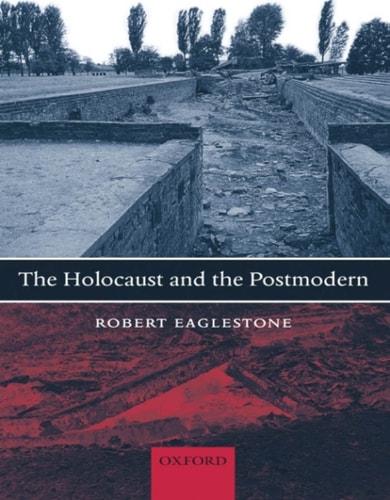
The Holocaust and the Postmodern
0
0
As an Amazon Associate and affiliate partner, Menrva Books earns from qualifying purchases. Learn more
Author Description
Robert Eaglestone argues that postmodernism, especially understood in the light of the work of Emmanuel Levinas and Jacques Derrida, is a response to the Holocaust. This way of thinking offers new perspectives on Holocaust testimony, literature, historiography, and post-Holocaust philosophy. While postmodernism is often derided for being either playful and superficial or obscure and elitist, Eaglestone argues and demonstrates its commitment both to the past and to ethics. Dealing with Holocaust testimony, including the work of Primo Levi and Eli Wiesel, with the memoirs of 'second generation' survivors and with recent Holocaust literature, including Anne Michael's Fugitive Pieces, Jonathan Safran Foer's Everything is Illuminated and the false memoir of Benjamin Wilkomirski, The Holocaust and the Postmodern proposes a new way of reading both Holocaust testimony and Holocaust fiction. Through an exploration of Holocaust historiography, the book offers a new approach to debates over truth and memory. Eaglestone argues for the central importance of the Holocaust in understanding the work of Emmanuel Levinas and Jacques Derrida, and goes on to explore what the Holocaust means for rationality, ethics, and for the idea of what it is to be human. Weaving together theory and practice, testimony, literature, history, philosophy, and Holocaust studies, this interdisciplinary book is the first to explore in detail the significance of the Holocaust for postmodernism, and the significance of postmodernism for understanding the Holocaust.
Menrva's Summary
THE THESIS
This book investigates the intersection of postmodern philosophy and the historical reality of the Holocaust, arguing that postmodernism functions as a profound ethical response to the trauma of the event. Robert Eaglestone, a scholar in contemporary literature and philosophy, utilizes the theoretical frameworks of Emmanuel Levinas and Jacques Derrida to re-evaluate how we interpret Holocaust testimony, historiography, and fiction. By bridging the gap between abstract theory and historical practice, the author demonstrates that postmodern thought possesses a rigorous commitment to ethics and the preservation of memory.
THE SCOPE MAP
What You Will Find
- Analysis of philosophical works by Emmanuel Levinas and Jacques Derrida in the context of the Holocaust.
- Critical readings of Holocaust literature, including works by Primo Levi, Elie Wiesel, Anne Michaels, and Jonathan Safran Foer.
- Examination of the historiographical debates surrounding truth, memory, and the nature of testimony.
- Discussion of the 'second generation' survivor experience and the implications of false memoirs like that of Benjamin Wilkomirski.
Scope Limits
- The text does not provide a comprehensive historical account of the Holocaust itself, focusing instead on the philosophical and literary reception of the event.
- It does not attempt to resolve all debates within postmodern theory, but rather focuses on its specific utility in understanding post-Holocaust ethics.
THE AUTHORITY PERSPECTIVE
Scholars and students of Holocaust studies frequently identify this work as a significant interdisciplinary bridge between continental philosophy and historical trauma. Readers often note the academic density of the prose, which requires a foundational familiarity with postmodern theory to fully grasp the author's arguments.
Page Count:
380
Publication Date:
2005-01-01
Publisher:
Oxford University Press
ISBN-10:
0191532789
ISBN-13:
9780191532788
History
Philosophy
Ethics
Literary Criticism
English & College Success
English
Postmodernism
Community Tags
Other Editions(4)


Similar Books

Reader Comments
Share Your Thoughts
No comments yet. Be the first to share your thoughts!