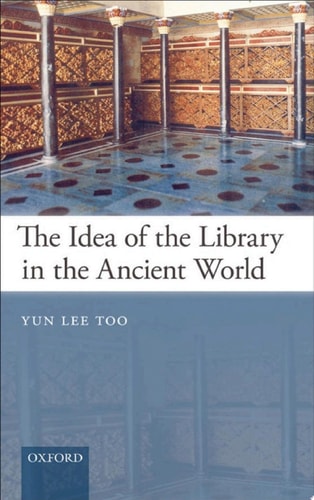
The Idea of the Library in the Ancient World
0
0
As an Amazon Associate and affiliate partner, Menrva Books earns from qualifying purchases. Learn more
Author Description
In The Idea of the Library in the Ancient World Yun Lee Too argues that the ancient library was much more than its incarnation at Alexandria, which has been the focus for students of the subject up till now. In fact, the library is a complex institution with many different forms. It can be a building with books, but it can also be individual people, or the individual books themselves. In antiquity, the library's functions are numerous: as an instrument of power, of memory, of which it has various modes; as an articulation of a political ideal, an art gallery, a place for sociality. Too indirectly raises important conceptual questions about the contemporary library, bringing to these the insights that a study of antiquity can offer.
Menrva's Summary
THE THESIS
This work investigates the multifaceted conceptualization of the library in antiquity, challenging the traditional focus on the Library of Alexandria as the singular model of ancient information storage. Yun Lee Too, a scholar of classical literature and culture, utilizes historical evidence and philosophical analysis to argue that the ancient library functioned as a dynamic institution. She posits that the library existed in various forms—ranging from physical structures to individual scholars—and served diverse roles including political instrument, repository of memory, and social space.
THE SCOPE MAP
What You Will Find
- Analysis of the library as a symbol of political power and social organization
- Examination of the library as a metaphorical entity embodied by individuals or collections
- Comparative study of various institutional forms beyond the Alexandrian model
Scope Limits
- Does not provide a comprehensive archaeological survey of every known ancient library site
- Does not focus on the technical preservation methods or physical construction materials of ancient scrolls
THE AUTHORITY PERSPECTIVE
Scholars and historians frequently cite this text for its conceptual breadth and its ability to bridge classical studies with modern library theory. Readers often note the academic density of the prose, which is intended for those with a background in classical history or information science.
Page Count:
277
Publication Date:
2010-01-01
Publisher:
OUP Oxford
ISBN-10:
0191610399
ISBN-13:
9780191610394
History
Cultural History
Ancient History
Libraries history
Community Tags
Similar Books