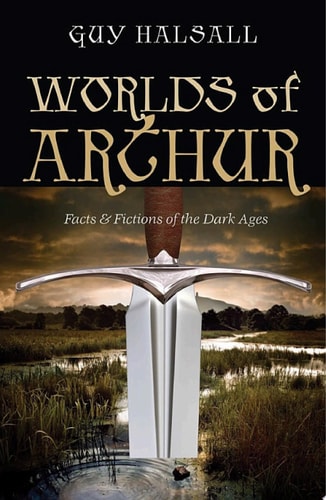
Worlds of Arthur: Facts and Fictions of the Dark Ages
0
0
As an Amazon Associate and affiliate partner, Menrva Books earns from qualifying purchases. Learn more
Author Description
King Arthur is probably the most famous and certainly the most legendary medieval king. From the early ninth century through the middle ages, to the Arthurian romances of Victorian times, the tales of this legendary figure have blossomed and multiplied. And in more recent times, there has been a continuous stream of books claiming to have discovered the 'facts' about, or to unlock the secret or truth behind, the 'once and future king'. Broadly speaking, there are two Arthurs. On the one hand is the traditional 'historical' Arthur, waging a doomed struggle to save Roman civilization against the relentless Anglo-Saxon tide during the darkest years of the Dark Ages. On the other is the Arthur of myth and legend - accompanied by a host of equally legendary people, places, and stories: Lancelot, Guinevere, Galahad and Gawain, Merlin, Excalibur, the Lady in the Lake, the Sword in the Stone, Camelot, the Round Table. The big problem with all this is that 'King Arthur' might well never have existed. And if he did exist, it is next to impossible to say anything at all about him. As this challenging new look at the Arthur legend makes clear, all books claiming to reveal 'the truth' behind King Arthur can safely be ignored. Not only the 'red herrings' in the abundant pseudo-historical accounts, even the 'historical' Arthur is largely a figment of the imagination: the evidence that we have - whether written or archaeological - is simply incapable of telling us anything detailed about the Britain in which he is supposed to have lived, fought, and died. The truth, as Guy Halsall reveals in this fascinating investigation, is both radically different - and also a good deal more intriguing.
Menrva's Summary
THE THESIS
This book investigates the historical validity of the King Arthur legend by examining the archaeological and textual evidence available for post-Roman Britain. Guy Halsall, a professional historian specializing in the early medieval period, utilizes a rigorous historiographical framework to dismantle popular claims regarding a 'historical' Arthur. He argues that the available evidence is insufficient to support the existence of a singular historical figure, suggesting instead that the legend serves as a lens for understanding the cultural anxieties of later periods.
THE SCOPE MAP
What You Will Find
- Analysis of early medieval textual sources and their reliability.
- Examination of archaeological data from the fifth and sixth centuries in Britain.
- Critique of pseudo-historical methodologies used to 'discover' Arthur.
- Exploration of how the Arthurian myth evolved from the ninth century to the Victorian era.
Scope Limits
- The book does not attempt to provide a new 'biography' or 'true identity' of Arthur.
- It does not focus on the literary analysis of later Arthurian romances, but rather on the historical context of their origins.
THE AUTHORITY PERSPECTIVE
Historians and medievalists frequently cite this work as a necessary corrective to speculative popular histories that prioritize myth over evidence. Readers often note the academic rigor of the prose, which serves as a foundational text for those seeking to understand the limitations of the historical record regarding the Dark Ages.
Page Count:
394
Publication Date:
2013-01-01
Publisher:
OUP Oxford
ISBN-10:
0191632716
ISBN-13:
9780191632716
History
Britons
British History
Mythology
Arthur king
Great Britain
Historiography
European History
Community Tags
Similar Books