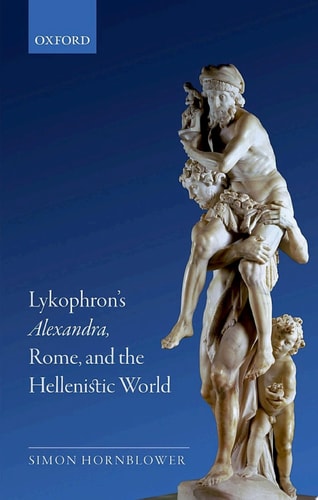
Lykophron's Alexandra, Rome, and the Hellenistic World
0
0
As an Amazon Associate and affiliate partner, Menrva Books earns from qualifying purchases. Learn more
Author Description
This volume takes as its subject one of the most important Greek poems of the Hellenistic period: the Alexandra attributed to Lykophron, probably written in about 190 BC. At 1474 lines and with a riddling narrative and a preponderance of unusual vocabulary it is a notoriously challenging prospect for scholars, but it also sheds crucial light on Greek religion (in particular the role of women) and on foundation myths and myths of colonial identity. Most of the poem purports to be a prophecy by the Trojan princess, Kassandra, who foretells the conflicts between Europe and Asia from the Trojan Wars to the establishment of Roman ascendancy over the Greek world in the poet's own time. The central section narrates in the future tense the dispersal of returning Greek heroes throughout the Mediterranean zone, and their founding of new cities. This section culminates in the Italian wanderings and foundational activity of the Trojan refugee Aineias, Kassandra's own kinsman. Following Simon Hornblower's detailed full-length commentary on the Alexandra (OUP 2015; paperback 2017), this monograph asserts the poem's importance as not only a strongly political work, but also as a historical document of interest to cultural and religious historians and students of myths of identity. Divided into two Parts, the first explores Lykophron's geopolitical world, paying special attention to south Italy (perhaps the bilingual poet's own area of origin), Sicily, and Rhodes; it suggests that the recent hostile presence of Hannibal in south Italy surfaces as a frequent yet indirectly expressed concern of the poem. The thematic second Part investigates the Alexandra's relation to the Sibylline Oracles and to other apocalyptic literature of the period, and argues for its cultural and religious topicality. The Conclusion puts the case for the 190s BC as a turning-point in Roman history and contends that Lykophron demonstrates a veiled awareness of this, especially of certain peculiar features of
Menrva's Summary
THE THESIS
This monograph investigates the historical and political significance of Lykophron's Alexandra, arguing that the poem serves as a sophisticated document reflecting the geopolitical anxieties of the Hellenistic world circa 190 BC. Simon Hornblower, a distinguished scholar of ancient history, utilizes his extensive expertise in Greek literature and Mediterranean history to analyze the poem's complex structure. He posits that the work is not merely a linguistic puzzle but a deliberate commentary on the rise of Roman power and the shifting cultural identities of the era.
THE SCOPE MAP
What You Will Find
- Analysis of the geopolitical landscape of South Italy, Sicily, and Rhodes during the 2nd century BC.
- Examination of the poem's relationship to Sibylline Oracles and apocalyptic literary traditions.
- Discussion of foundation myths and the role of women in Greek religious practice.
Scope Limits
- The text does not provide a general history of the Hellenistic period, focusing specifically on the context surrounding the Alexandra.
- It does not offer a line-by-line translation, assuming the reader has access to the author's previous full-length commentary.
THE AUTHORITY PERSPECTIVE
Scholars recognize this work as a vital companion to Hornblower's earlier commentary, providing necessary historical context for a notoriously difficult text. Experts highlight the monograph's ability to bridge the gap between philological analysis and historical interpretation for advanced students of the ancient world.
Page Count:
278
Publication Date:
2018-01-01
Publisher:
OUP Oxford
ISBN-10:
0192524232
ISBN-13:
9780192524232
History
English
Hellenistic History
Literary Criticism
Ancient Mythology
English & College Success
Greek poetry
Community Tags
Other Editions(3)
Similar Books







Reader Comments
Share Your Thoughts
No comments yet. Be the first to share your thoughts!