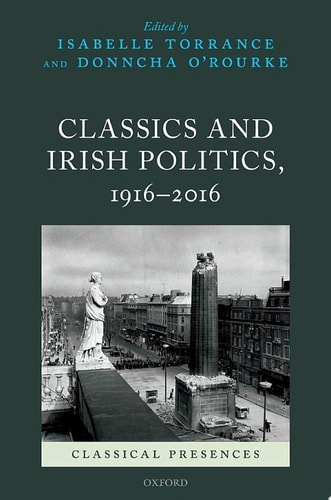
Classics and Irish Politics, 1916-2016
0
0
As an Amazon Associate and affiliate partner, Menrva Books earns from qualifying purchases. Learn more
Author Description
This collection addresses how models from ancient Greece and Rome have permeated Irish political discourse in the century since 1916. The 1916 Easter Rising, when Irish nationalists rose up against British imperial forces, became almost instantly mythologized in Irish political memory as a turning point in the nation's history that paved the way for Irish independence. Its centenary has provided a natural point for reflection on Irish politics, and this volume highlights an unexplored element in Irish political discourse, namely its frequent reliance on, reference to, and tensions with classical Greek and Roman models. Topics covered include the reception and rejection of classical culture in Ireland; the politics of Irish language engagement with Greek and Roman models; the intersection of Irish literature with scholarship in Classics and Celtic Studies; the use of classical referents to articulate political inequalities across gender, sexual, and class hierarchies; meditations on the Northern Irish conflict through classical literature; and the political implications of neoclassical material culture in Irish society. As the only country colonized by Britain with a pre-existing indigenous heritage of expertise in classical languages and literature, postcolonial Ireland represents a unique case in the field of classical reception. This book opens a window on a rich and varied dialogue between significant figures in Irish cultural history and the Greek and Roman sources that have inspired them, a dialogue that is firmly rooted in Ireland's historical past and continues to be ever-evolving.
Menrva's Summary
THE THESIS
This collection investigates how classical Greek and Roman models have influenced and permeated Irish political discourse and national identity in the century following the 1916 Easter Rising. Editors Donncha O'Rourke and Isabelle Torrance compile scholarly essays that examine the unique intersection of Irish postcolonial politics and the classical tradition. The volume argues that Ireland's distinct history—as a British colony with an indigenous tradition of classical scholarship—created a specific framework for how ancient texts and myths were utilized to articulate political, social, and gender-based hierarchies.
THE SCOPE MAP
What You Will Find
- Analysis of the reception and rejection of classical culture in Irish political memory.
- Examination of the intersection between Irish literature, Celtic Studies, and classical scholarship.
- Case studies on the use of classical referents in discussions of gender, class, and the Northern Irish conflict.
- Exploration of neoclassical material culture within Irish society.
Scope Limits
- The volume focuses primarily on the period between 1916 and 2016.
- It does not provide a comprehensive history of Irish politics, but rather a thematic study of classical reception within that political context.
THE AUTHORITY PERSPECTIVE
Scholars in the field of classical reception identify this work as a significant contribution to understanding the postcolonial application of ancient models in modern nation-building. Readers frequently note the academic density of the prose, which is intended for researchers and students of Irish history and classical studies.
Page Count:
490
Publication Date:
2020-01-01
Publisher:
OUP Oxford
ISBN-10:
0192633457
ISBN-13:
9780192633453
History
Cultural History
English & College Success
Irish History
Great Britain
English
Community Tags
Other Editions(3)
Similar Books



Reader Comments
Share Your Thoughts
No comments yet. Be the first to share your thoughts!