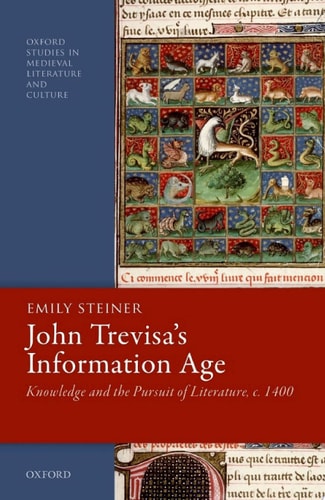
John Trevisa's Information Age: Knowledge and the Pursuit of Literature, c. 1400
0
0
As an Amazon Associate and affiliate partner, Menrva Books earns from qualifying purchases. Learn more
Author Description
What would medieval English literature look like if we viewed it through the lens of the compendium? In that case, John Trevisa might come into focus as the major author of the fourteenth century. Trevisa (d. 1402) made a career of translating big informational texts from Latin into English prose. These included Ranulph Higden's Polychronicon, an enormous universal history, Bartholomaeus Anglicus's well-known natural encyclopedia De proprietatibus rerum, and Giles of Rome's advice-for-princes manual, De regimine principum. These were shrewd choices, accessible and on trend: De proprietatibus rerum and De regimine principum had already been translated into French and copied in deluxe manuscripts for the French and English nobility, and the Polychronicon had been circulating England for several decades. This book argues that John Trevisa's translations of compendious informational texts disclose an alternative literary history by way of information culture. Bold and lively experiments, these translations were a gamble that the future of literature in England was informational prose. This book argues that Trevisa's oeuvre reveals an alternative literary history more culturally expansive and more generically diverse than that which we typically construct for his contemporaries, Geoffrey Chaucer and William Langland. Thirteenth- and early fourteenth-century European writers compiled massive reference books which would shape knowledge well into the Renaissance. This study maintains that they had a major impact on English poetry and prose. In fact, what we now recognize to be literary properties emerged in part from translations of medieval compendia with their inventive ways of handling vast quantities of information.
Menrva's Summary
THE THESIS
How did the translation of medieval compendia shape the development of English literary culture and the concept of informational prose? Emily Steiner, a scholar of medieval literature, examines the career of John Trevisa to argue that his translations of encyclopedic and historical texts represent a significant, often overlooked, contribution to the formation of English literary identity. By analyzing these works, the author posits that informational prose was a central, rather than peripheral, force in the evolution of English writing during the fourteenth century.
THE SCOPE MAP
What You Will Find
- Analysis of John Trevisa's translations, including the Polychronicon and De proprietatibus rerum.
- Examination of the relationship between medieval compendia and the emergence of literary properties.
- Comparative study of Trevisa's work against the established canon of Chaucer and Langland.
- Historical context regarding the circulation of Latin and French informational texts in medieval England.
Scope Limits
- The study focuses primarily on the fourteenth-century English context and does not provide an exhaustive history of European encyclopedias.
- It does not attempt to provide a comprehensive biography of Trevisa beyond his role as a translator.
THE AUTHORITY PERSPECTIVE
Scholars in the field of medieval studies recognize this work as a significant re-evaluation of the literary canon, highlighting the importance of informational prose in the late Middle Ages. Readers frequently note the academic density of the prose and the author's meticulous archival research.
Page Count:
432
Publication Date:
2021-01-01
Publisher:
OUP Oxford
ISBN-10:
0192650831
ISBN-13:
9780192650832
History
English literature
English & College Success
Translation Studies
Literary Criticism
Cultural History
English