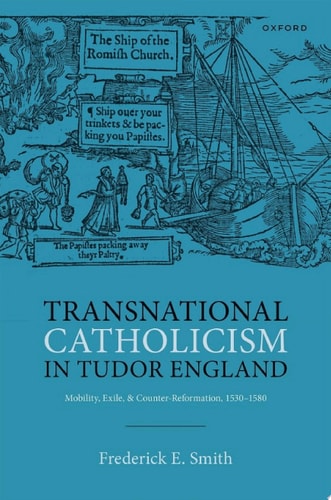
Transnational Catholicism in Tudor England: Mobility, Exile, and Counter-Reformation, 1530-1580
0
0
As an Amazon Associate and affiliate partner, Menrva Books earns from qualifying purchases. Learn more
Author Description
Transnational Catholicism in Tudor England details the relationship between transnational mobility and the development of Tudor Catholicism. Almost two hundred Catholics felt compelled to exile themselves from England rather than conform with the religious reformations inaugurated by Henry VIII and Edward VI. Frederick E. Smith explores how these émigrés' physical mobility reconfigured their relationships with the men and women they left behind, and how it forced them to develop new relationships with individuals they encountered abroad. It analyses how the experiences of mobility and displacement catalysed a shift in their religious identities, in some ways broadening but in others narrowing their understandings of what it meant to be 'Catholic'. The author examines the role of these émigrés as agents of religious exchange, circulating new doctrinal and devotional ideas throughout western Europe and forging new connections between them. By focussing particularly upon those individuals who subsequently returned to their homeland during Mary I's Catholic counter-reformation, the study also explores the lasting legacies of these émigrés' displacement and mobility, both for the émigrés themselves as they grappled with the difficulties of re-integration, but also for the broader development of English Catholicism. In this way, Transnational Catholicism in Tudor England deepens our understanding of the complex and sometimes contradictory ways in which exile shapes religio-political identities, but also underlines the importance of international mobility as a crucial factor in the development of English Catholicism and the wider European Catholic Church over the mid sixteenth century.
Menrva's Summary
THE THESIS
This study investigates how the forced migration and transnational mobility of English Catholics between 1530 and 1580 fundamentally reconfigured their religious identities and the broader development of the Counter-Reformation. Frederick E. Smith, a scholar of early modern religious history, utilizes archival records and correspondence to track the movement of nearly two hundred émigrés. The author argues that physical displacement served as a catalyst for doctrinal exchange, forcing exiles to navigate new social and theological landscapes while maintaining ties to their homeland.
THE SCOPE MAP
What You Will Find
- Analysis of the socio-political impact of the English Reformation on Catholic populations.
- Examination of the circulation of devotional ideas across Western Europe.
- Case studies of émigrés who returned to England during the reign of Mary I.
Scope Limits
- The study focuses primarily on the period between 1530 and 1580.
- It does not provide an exhaustive biography of every individual exile, but rather focuses on the collective experience of mobility.
THE AUTHORITY PERSPECTIVE
Historians and scholars of the Tudor period frequently cite this work for its nuanced approach to the intersection of geography and religious identity. Experts highlight the text as a significant contribution to the study of transnational networks in the sixteenth century.
Page Count:
296
Publication Date:
2022-01-01
Publisher:
OUP Oxford
ISBN-10:
0192690825
ISBN-13:
9780192690821
History
European History
Europe
Tudor England
Exile Studies
Catholicism
Religious History