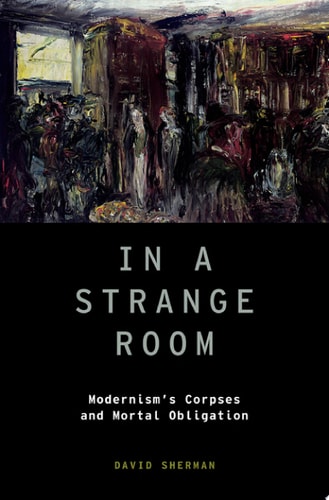
In a Strange Room: Modernism's Corpses and Mortal Obligation
0
0
As an Amazon Associate and affiliate partner, Menrva Books earns from qualifying purchases. Learn more
Author Description
Literary modernism emerged as death, stripped in the developing world of traditional meanings and practices, became strange. The sea-change over the first part of the twentieth century in how people died and tended corpses-the modernization of death-was a crucial context in which modernist writers developed their new novelistic and poetic techniques. They sought ways to renovate mortal obligations in an age of the obsolescence of the dead.For many years, the flesh-and-blood body has been a central protagonist in literary scholarship--the body in pain, the body as spectacle and performance, embodiments of social identity--but the body in its mortality, as corpse, has not received sustained critical attention. Filling this gap, In a Strange Room investigates modernism's preoccupation with corpses, death rituals, and the ethical demands the dead make on the living who survive them.Informed by insights from psychology, anthropology, political theory, and philosophy, David Sherman shows how modernist aesthetics sought to re-animate the complex meanings and values of dead bodies during an era of their efficient, medical administration and hygienic disposal. The modernist imagination reckoned with the processes by which the modern corpse became a secularized object increasingly subject to scientific inquiry, governmental regulation, specialized medical technologies, and new forms of market exchange. Chapters explore representations of state power over the war dead in Virginia Woolf and Wilfred Owen, the narrative problem of the unburied corpse in As I Lay Dying and Ulysses, mortal obligation as erotic desire in Eliot's The Waste Land and Djuna Barnes's Nightwood, and mortuary pedagogies embedded in elegies by Wallace Stevens and William Carlos Williams.Gathering examples from fiction, poetry, and the visual arts, In a Strange Room considers the changing relationship between aesthetics and mortality during the first half of the twentieth century.
Menrva's Summary
THE THESIS
This work investigates how the modernization of death and the medicalization of the corpse during the early twentieth century fundamentally shaped the aesthetic and ethical concerns of modernist literature. David I. N. Sherman, drawing upon interdisciplinary frameworks including anthropology, political theory, and psychology, argues that modernist writers utilized new narrative and poetic techniques to address the obsolescence of traditional death rituals. By examining the transition of the corpse into a secularized, regulated object, the author demonstrates how literature attempted to renovate the moral obligations owed by the living to the dead in an era of hygienic disposal and state-managed mortality.
THE SCOPE MAP
What You Will Find
- Analysis of state power and the war dead in the works of Virginia Woolf and Wilfred Owen.
- Examination of the narrative challenges posed by unburied corpses in William Faulkner's As I Lay Dying and James Joyce's Ulysses.
- Exploration of mortal obligation through the lens of erotic desire in T.S. Eliot's The Waste Land and Djuna Barnes's Nightwood.
- Investigation of mortuary pedagogies within the elegiac poetry of Wallace Stevens and William Carlos Williams.
- Synthesis of visual arts, fiction, and poetry to map the changing relationship between aesthetics and mortality.
THE AUTHORITY PERSPECTIVE
Scholars recognize this text as a significant contribution to the field of modernist studies, particularly for its focus on the neglected materiality of the corpse. Readers frequently note the academic density of the prose and the rigorous interdisciplinary approach employed to bridge literary analysis with cultural history.
Page Count:
288
Publication Date:
2014-01-01
Publisher:
Oxford University Press
ISBN-10:
0199333890
ISBN-13:
9780199333899
Philosophy
Sociology of Death
Death Studies
Modernism
Cultural History
English
English & College Success
Literary Criticism
Community Tags
Other Editions(2)
Similar Books



Reader Comments
Share Your Thoughts
No comments yet. Be the first to share your thoughts!