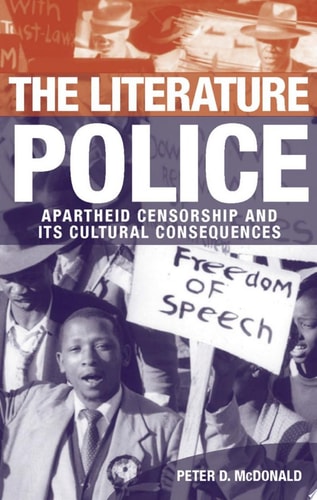
The Literature Police: Apartheid Censorship and Its Cultural Consequences
0
0
As an Amazon Associate and affiliate partner, Menrva Books earns from qualifying purchases. Learn more
Author Description
'Censorship may have to do with literature', Nadine Gordimer once said, 'but literature has nothing whatever to do with censorship.'As the history of many repressive regimes shows, this vital borderline has seldom been so clearly demarcated. Just how murky it can sometimes be is compellingly exemplified in the case of apartheid South Africa. For reasons that were neither obvious nor historically inevitable, the apartheid censors were not only the agents of the white minority government's repressive anxieties about the medium of print. They were also officially-certified guardians of the literary. This book is centrally about the often unpredictable cultural consequences of this paradoxical situation.Peter D. McDonald brings to light a wealth of new evidence - from the once secret archives of the censorship bureaucracy, from the records of resistance publishers and writers' groups both in the country and abroad - and uses extensive oral testimony. He tells the strangely tangled stories of censorship and literature in apartheid South Africa and, in the process, uncovers an extraordinarily complex web of cultural connections linking Europe and Africa, East and West.The Literature Police affords a unique perspective on one of the most anachronistic, exploitative, and racist modern states of the post-war era, and on some of the many forms of cultural resistance it inspired. It also raises urgent questions about how we understand the category of the literary in today's globalized, intercultural world.
Menrva's Summary
THE THESIS
This book investigates the paradoxical role of apartheid-era censors who functioned simultaneously as agents of state repression and as self-appointed guardians of literary standards. Peter D. McDonald, a scholar of literature and history, utilizes previously classified government archives, records from resistance publishers, and extensive oral testimonies to reconstruct the complex relationship between state control and creative expression. He argues that the censorship apparatus in South Africa created unforeseen cultural consequences that linked local resistance movements to broader global intellectual networks.
THE SCOPE MAP
What You Will Find
- Analysis of secret censorship bureaucracy archives from the apartheid era.
- Examination of the intersection between state-mandated repression and the definition of literary value.
- Primary source evidence from resistance writers' groups and underground publishing networks.
- A critical inquiry into the globalized understanding of literature and cultural resistance.
THE AUTHORITY PERSPECTIVE
Scholars and historians frequently cite this work as a definitive study on the mechanics of state-sponsored cultural suppression. Experts highlight the text for its meticulous archival research and its ability to illuminate the nuanced, often contradictory, relationship between political authority and the arts.
Page Count:
432
Publication Date:
2010-12-01
Publisher:
Oxford University Press
ISBN-10:
0199591113
ISBN-13:
9780199591114
History
Politics
Sociology
South Africa
South African
English
Censorship
English & College Success
Literary Criticism