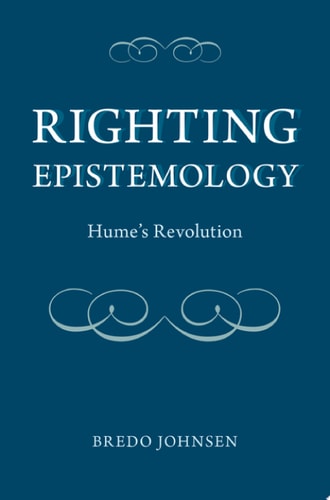
Righting Epistemology
0
0
As an Amazon Associate and affiliate partner, Menrva Books earns from qualifying purchases. Learn more
Author Description
David Hume Launched A Historic Revolution In Epistemology When He Showed That Our Theories About The World Have No Probability Relative To What We Think Of As Our Evidence For Them, Hence That The Distinction Between Justified And Unjustified Theories Does Not Lie In Their Different Probabilities Relative To That Evidence. However, Allies In His Revolution Appeared Only In The 20th Century, In The Persons Of Sir Karl Popper, Nelson Goodman And W. V. Quine. Hume's Second Great Contribution To The Field, Which Remains Unrecognized To This Day, Was To Propose What Is Now Known As Reflective Equilibrium Theory As The Framework Within Which Justified And Unjustified Theories Are Rightly Distinguished. The Core Of This Book Comprises An Account Of These Developments From Hume To Quine, An Extension Of Reflective Equilibrium Theory That Renders It A General Theory Of Epistemic Justification Concerning Our Beliefs About The World, And An Argument That All Four Of These Thinkers Would Have Endorsed That Extension. In Chapters On Sextus, Descartes, Wittgenstein's On Certainty, And Other Aspects Of Hume's Epistemology I Defend New Readings Of Those Philosophers' Writings On Skepticism And Note Significant Relationships Among Their Views On Matters Bearing On The Humean Revolution. Finally, In Chapters On Hilary Putnam's Brains In A Vat And Fred Dretske's Contextualism - The Only Promising Version Of That View - I Show That Both Fail To Rule Out The Possible Truth Of Radical Skeptical Hypotheses. This Is Not Surprising, Since Those Hypotheses Are In Fact Possible. They Are Not, However, Of Any Epistemological Significance, Since The Justification Of Our Beliefs About The World Is A Function Of The Extent To Which Bodies Of Beliefs To Which They Belong Are In Reflective Equilibrium, And No Extant Conception Of Knowledge Is Of Any Epistemological Interest.
Menrva's Summary
THE THESIS
This book investigates the core question of how we can distinguish between justified and unjustified theories about the world in the wake of David Hume's epistemological revolution. Bredo Johnsen, a philosopher specializing in the history of epistemology, argues that Hume's overlooked contribution—Reflective Equilibrium Theory—provides the necessary framework for epistemic justification. By tracing this concept from Hume through 20th-century thinkers like Popper, Goodman, and Quine, the author proposes an extension of the theory to serve as a general account of belief justification.
THE SCOPE MAP
What You Will Find
- A historical analysis of the Humean revolution in epistemology.
- An extension of Reflective Equilibrium Theory as a general model for justification.
- Critical examinations of Sextus, Descartes, Wittgenstein, Hilary Putnam, and Fred Dretske.
Scope Limits
- The text does not provide a defense of knowledge as traditionally conceived, arguing instead that such conceptions lack epistemological interest.
- It does not attempt to refute radical skeptical hypotheses, focusing instead on their lack of significance.
THE AUTHORITY PERSPECTIVE
This work is intended for advanced students and professional philosophers familiar with analytic epistemology and the history of skepticism. Readers frequently note the technical density of the prose and the author's rigorous, argumentative approach to reinterpreting canonical philosophical texts.
Page Count:
256
Publication Date:
2017-01-01
Publisher:
Oxford University Press
ISBN-10:
0190662786
ISBN-13:
9780190662783
Philosophy
Metaphilosophy
Skepticism
Philosophy history
Epistemology
Community Tags
Other Editions(2)

Similar Books